.jpg)
At some point, every growing company hits the same question: who owns technology decisions? The product roadmap is getting more ambitious, the engineering team is growing, investors are asking harder questions, and the founder can no longer carry technical direction alone.
The choice usually comes down to fractional CTO vs full-time CTO. A fractional CTO provides senior technology leadership on a flexible or part-time basis. A full-time CTO becomes a permanent executive responsible for the company's entire technology organization.
Neither model is better by default. The right choice depends on your company stage, engineering team size, technology complexity, how strategic technology is to your business, how much leadership involvement you need, and where you plan to grow.
This guide breaks down what each role does, where each fits, and how to decide which model matches your situation today.
A fractional CTO is a senior technology leader who works with a company on a part-time or flexible basis, owning technology strategy, architecture, engineering direction and technical decision-making without joining as a permanent full-time executive. Companies use fractional CTOs when they need experienced technical leadership before a permanent CTO role is justified.
You will also hear the role described as a part-time CTO, virtual CTO or outsourced CTO. The labels differ, but the core idea is the same: executive-level technical judgment, applied at the level of involvement the company needs right now.
In practice, fractional CTO responsibilities typically cover:
The key distinction is ownership. A good fractional CTO does not just give opinions. They take responsibility for technical direction within an agreed scope and stay accountable for the outcomes.
Some providers package this as part of a broader offering. 5Blue's CTO-as-a-Service, for example, includes a fractional CTO and board-level advisory model alongside options such as architectural audits, technical due diligence preparation and a fully managed R&D department.
A full-time CTO is a permanent member of the executive team who owns technology across the organization over the long term. The role is less about individual technical decisions and more about building the organization that makes those decisions well.
A permanent CTO is typically responsible for:
As technology organizations grow, this kind of daily, embedded executive leadership often becomes necessary. A company with several engineering teams, a complex platform and technology at the core of its competitive advantage will usually need a permanent CTO. Fractional leadership is not a replacement for that at every stage. It is a better fit for specific stages and situations.
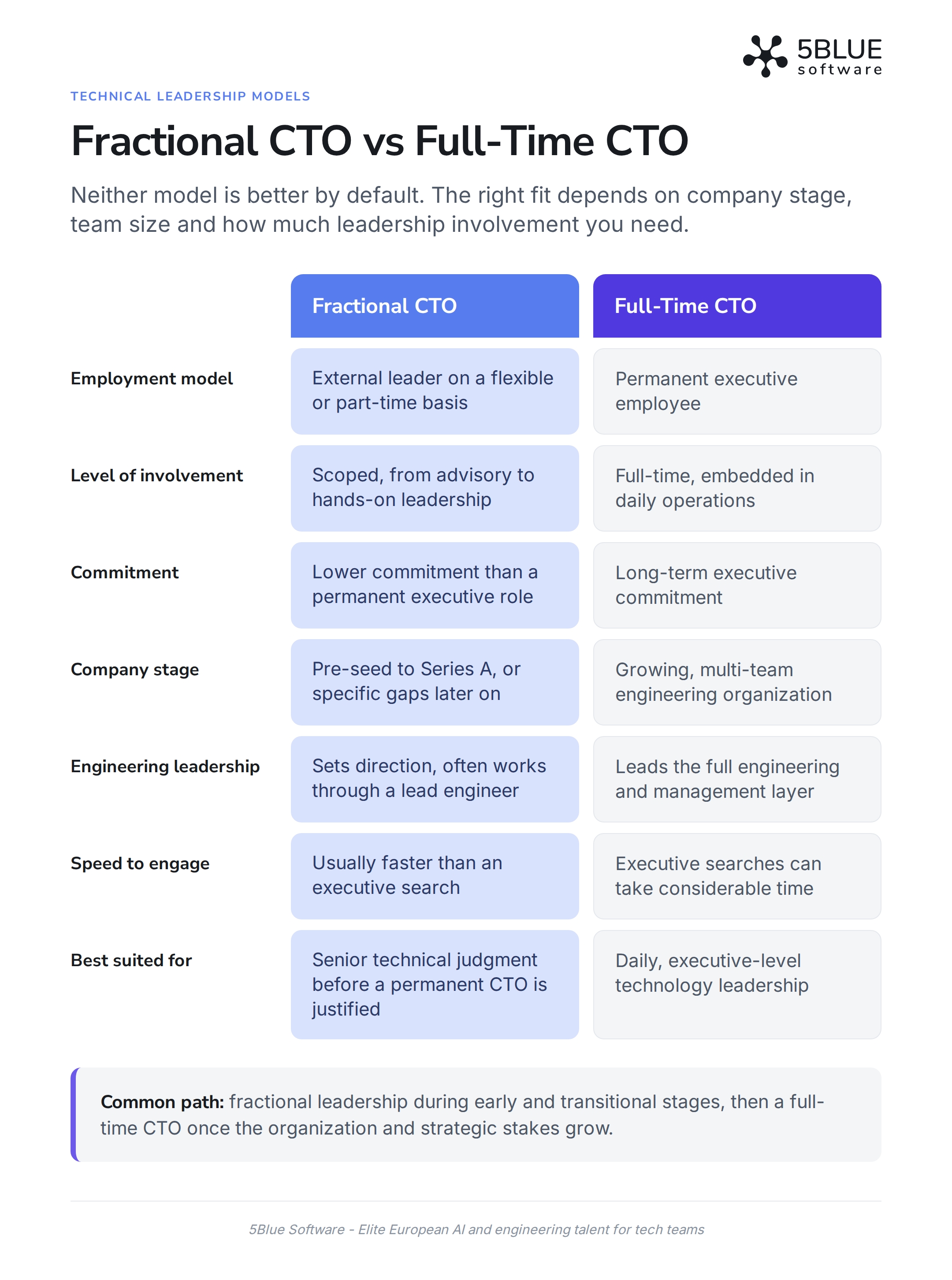
The financial difference is qualitative but real. A fractional arrangement avoids committing to a permanent executive hire too early, and the scope depends on business requirements. A full-time CTO is a larger, longer-term commitment that makes sense once the company needs that level of ongoing ownership.
Definitions only go so far. Here is what the work looks like inside a real company.
A fractional CTO starts by connecting technology to the business plan. If a B2B SaaS company plans to move upmarket within a year, that has technical consequences: single sign-on, audit logs, role-based access, data residency and uptime commitments. The fractional CTO makes those implications visible early so they are planned, not discovered during an enterprise sales cycle.
Strategy also means saying no. Not every feature needs custom engineering, and not every problem needs a new platform.
Many companies arrive with a codebase built quickly by freelancers, an agency or a founding engineer who has since left. The fractional CTO reviews what exists and answers practical questions: Can this handle ten times the current load? Where are the single points of failure? Is the data model going to block the next product line?
The outcome is not always "rebuild." Often it is a targeted plan: refactor one service, move one workload, fix the deployment process, and leave the rest alone.
Product teams think in features. Engineering teams think in systems. The technical roadmap connects the two, sequencing infrastructure work, refactoring and new functionality so the team can ship what the business needs without accumulating debt that stalls delivery six months later.
A good roadmap also makes trade-offs explicit, so founders know what they are choosing when they push a feature forward.
Small teams often run on goodwill and memory. That breaks around the point where a few engineers become a real team. A fractional CTO introduces the minimum process needed: code review standards, branching and release practices, automated testing, incident handling and a clear definition of done.
The goal is predictability, not bureaucracy. Founders should be able to ask "when will this ship?" and get an answer they can rely on.
Hiring is where many non-technical founders feel most exposed. They cannot easily judge whether a candidate is strong, whether a role is defined correctly, or whether they need a senior backend engineer or a DevOps specialist.
A fractional CTO defines the roles, designs the technical assessment, interviews candidates and decides which capabilities belong in-house and which can be extended externally. Companies that need to add capacity quickly can pair technical leadership with staff augmentation for vetted software engineers, keeping the CTO focused on direction while the team grows. For a deeper look at that trade-off, see our guide on when to hire in-house vs. bring in an outstaffed tech team.
Technical risk is rarely dramatic until it is. It includes security gaps, missing backups, dependency on one engineer who knows how production works, unmaintained libraries and vendor lock-in. A fractional CTO identifies these risks, ranks them by business impact and addresses the ones that could hurt the company first.
This is also where due diligence readiness starts. Investors and acquirers will look for exactly these issues.
Scaling is not only about servers. It covers the architecture, the team, the processes and the observability needed to know what is happening in production. A fractional CTO plans capacity ahead of growth, introduces monitoring and alerting, and makes sure the team structure can absorb new hires without slowing down. Our article on how to scale an engineering team without losing product quality covers the people side of this in more detail.
Many leadership teams feel pressure to "add AI" without a clear view of where it creates value. A fractional CTO helps separate useful applications from experiments that go nowhere: which workflows benefit from LLMs, whether retrieval-augmented generation fits the data, what evaluation and monitoring are needed, and what data governance the business requires.
When the use case is clear, the next question is execution. Companies with a working product and limited in-house AI expertise can work with a partner on AI implementation, from strategy and architecture to production deployment. Before committing, it is worth reviewing a structured AI integration roadmap for non-AI-native startups.
This is one of the most valuable parts of the role and one of the least discussed. Engineers explain problems in technical terms. Founders, boards and customers need to understand them in business terms: timelines, risk, revenue impact.
For non-technical founders, this translation is critical. Without it, they either accept engineering estimates without the ability to challenge them, or they push for speed without understanding what they are trading away. A fractional CTO gives the founder an informed voice in technical decisions and gives the engineering team a leader who can represent their constraints to the business.
If you are weighing fractional technology leadership against a permanent hire, it helps to talk it through with someone who has seen both. Book a conversation with 5Blue about your current technical challenges, company stage and the level of technical leadership your team needs.
Knowing when to hire a CTO is often harder than knowing how. These are the situations where a fractional CTO for startups tends to make the most sense.
You have a clear product vision and a market to go after, but no technical co-founder. You may have already worked with freelancers or an agency and ended up with code you cannot evaluate. A fractional CTO gives you a senior technical partner who can own architecture and vendor decisions, review what has been built, and make sure you are not making irreversible technical choices blind.
The MVP stage is where early decisions quietly shape the next several years. Choosing the wrong stack, over-engineering for scale you do not have, or under-investing in data structure all create problems later. A startup CTO at this stage defines scope, picks a sensible architecture and keeps the build focused on validating the business.
If you also need the build itself, you can combine technical leadership with a custom software development partner that delivers MVPs and full-scale products, so strategy and execution stay connected.
Going from two engineers to eight changes everything. Informal communication stops working, code quality becomes inconsistent and nobody owns the overall architecture. A fractional CTO introduces structure, defines roles and often mentors a senior engineer toward a team lead or engineering manager position.
Common warning signs: releases keep slipping, bugs reappear after being fixed, estimates are unreliable, and the founder spends evenings mediating between product and engineering. These are usually symptoms of missing technical leadership rather than a weak team. A fractional CTO diagnoses the root causes, whether process, architecture, skills or priorities, and fixes them in order.
Hiring your first senior engineers without technical judgment is risky. A bad early hire can set the wrong standards for everyone who follows. A fractional CTO writes the role profiles, designs the interview process, assesses candidates and helps decide which roles should be permanent and which can be filled through extended teams.
Investors increasingly look beyond the pitch deck. Technical due diligence can examine architecture, scalability, security, code quality, IP ownership and team dependency. A fractional CTO prepares documentation, closes obvious gaps and helps the founding team answer technical questions with confidence. Some CTO services include dedicated due diligence preparation, including mock sessions and security and compliance readiness reviews.
The product works, customers are growing, and the system is starting to strain. Performance degrades under load, deployments are risky, and infrastructure is held together by manual steps. A fractional CTO assesses whether you need targeted fixes or a staged re-architecture, and plans the work so the product keeps running while it improves.
AI features bring new questions: model selection, data pipelines, evaluation, latency, compliance and ongoing operations. They also bring new roles. A fractional CTO defines the approach and the team you need to support it. Our guide on building an AI team from scratch and the roles you need beyond the AI engineer is a useful companion here.
Sometimes the real answer is that you need senior technical leadership, but not every day, and not yet as a permanent executive. You may be between funding rounds, still validating product-market fit, or waiting until the engineering organization is large enough to justify a full-time CTO. Fractional leadership covers that gap and can help define the permanent role when the time comes.
Recognize your company in one or more of these scenarios? A short conversation can clarify what kind of technical leadership fits your stage. Talk to 5Blue about your engineering structure, technology roadmap and where you need support.
Fractional leadership has limits. A full-time CTO is usually the right choice when:
Many companies follow a natural path: a fractional CTO during the early and transitional stages, then a full-time CTO once the organization and the strategic stakes grow. A good fractional CTO will tell you when you have reached that point.
The fractional CTO vs consultant distinction comes down to scope and ownership.
A technical consultant typically advises on or solves a defined problem. A fractional CTO takes broader ownership of technology direction and leadership over time.
In practice, the two roles differ on five points:
Both have their place. If you need an expert opinion on a narrow question, a consultant is often the right choice. If you need someone to own the answer to the bigger question, and live with the consequences, you need a CTO, whether fractional or full-time.
The terms are often used interchangeably, but they can mean different things.
A fractional CTO is typically an individual senior technology leader working with the company on a flexible basis. The value depends heavily on that one person's experience, availability and network.
CTO as a Service is a broader model. Depending on the provider, it may combine senior technical leadership with access to engineering resources, specialist expertise and implementation support. Instead of a single advisor who then has to find a team, the company gets leadership and delivery capacity connected from the start.
Which one fits depends on what you are missing. If you already have a capable engineering team and need senior direction, an individual fractional CTO may be enough. If you need direction and the people to execute it, a CTO-as-a-Service model reduces the number of handoffs between strategy and delivery.
5Blue's CTO-as-a-Service is built around several engagement models, including an architectural audit and scalability roadmap, ongoing fractional CTO and board-level advisory, technical due diligence preparation, emergency CTO intervention, team mentorship, and a fully managed R&D department where a senior engineering team works under the direction of 5Blue's CTO. It is aimed primarily at non-technical founders at Seed or Series A stage who have a clear product vision but no technical foundation yet.
Use these questions to assess where your company stands:
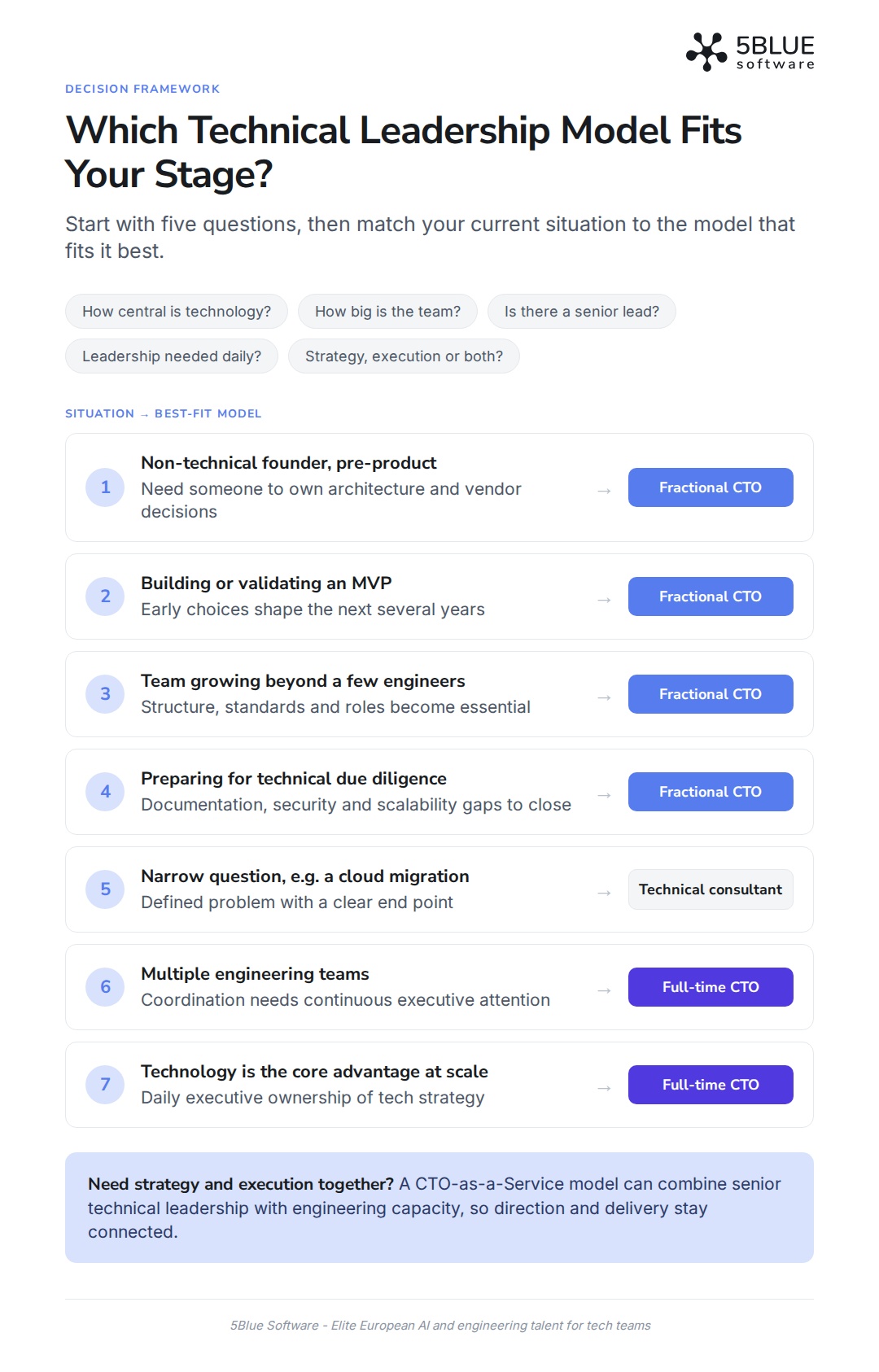
These are the patterns we see most often when companies get this decision wrong.
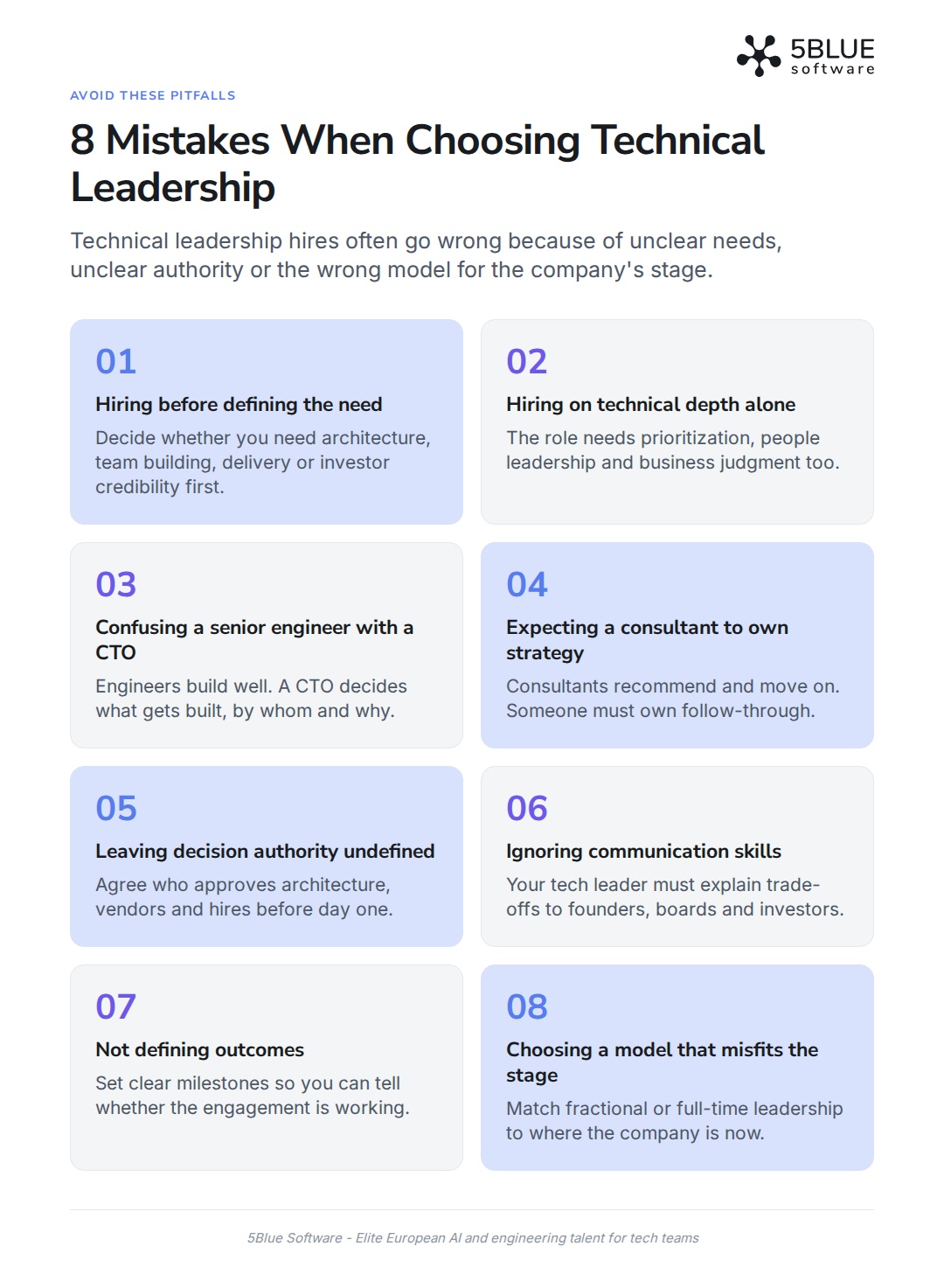
Hiring a CTO before defining what the company needs. "We need a CTO" is not a job description. Decide first whether you need architecture, team building, delivery management, investor credibility or all of them. The answer shapes the model.
Hiring based only on technical depth. The strongest engineer is not always the best CTO. The role requires prioritization, people leadership and business judgment as much as technical skill.
Ignoring business understanding. A CTO who does not understand your market, customers and revenue model will optimize for the wrong things, such as elegant systems that do not move the business forward.
Confusing a senior engineer with a CTO. A senior engineer builds well. A CTO decides what should be built, by whom, in what order and why. Giving a strong engineer the CTO title without that scope often frustrates everyone.
Expecting a consultant to own technology strategy. Consultants deliver recommendations and move on. If nobody owns implementation and follow-through, the recommendations stay in a document.
Hiring leadership without defining decision authority. Can the fractional CTO approve architecture changes? Veto a vendor? Make hiring calls? If this is unclear, the engagement stalls and the team does not know whose direction to follow.
Ignoring communication skills. Your technical leader will talk to investors, customers, the board and non-technical colleagues. If they cannot explain trade-offs clearly, their technical judgment loses much of its value.
Failing to define outcomes. Agree upfront on what success looks like: a stable release process, a hiring plan executed, an architecture roadmap approved, due diligence passed. Without outcomes, it is hard to tell whether the engagement is working.
Choosing a model that does not fit the company's stage. A full-time CTO at pre-seed can lock in a senior executive before the company knows what it needs. A part-time CTO for a company with several engineering teams can leave the organization under-led. Match the model to the stage, and revisit it as the company changes.
Before you hire a fractional CTO, assess candidates or providers against this checklist:
A fractional CTO is a senior technology leader who works with a company on a part-time or flexible basis. They own technology strategy, architecture, engineering direction and key technical decisions without joining as a permanent full-time executive. Companies typically use fractional CTOs when they need experienced technical leadership before a permanent CTO role is justified.
A fractional CTO sets technology strategy, reviews and designs architecture, builds the technical roadmap, establishes engineering processes and helps hire the engineering team. They also manage technical risk, prepare systems for scale, guide AI adoption and translate between business goals and engineering work. The exact scope depends on the company's stage and needs.
A startup should consider a fractional CTO when it lacks senior technical leadership but does not yet need a permanent CTO. Common triggers include a non-technical founder building a product, an MVP in development, a growing engineering team, difficulty managing delivery, upcoming technical due diligence, scaling problems or plans to introduce AI into the product.
There is no standard. Involvement ranges from a few hours a week of advisory support to several days a week of hands-on leadership, depending on the company's stage, team size and priorities. Many engagements start with more intensive involvement during an initial assessment, then settle into a regular rhythm as processes and ownership become clearer.
A fractional CTO provides senior technology leadership on a flexible basis, with involvement defined by scope. A full-time CTO is a permanent executive who owns the entire technology organization every day, including long-term strategy, engineering culture and board-level accountability. Fractional suits earlier or transitional stages. Full-time suits larger, technology-driven organizations.
A technical consultant usually advises on a specific, defined problem, such as a cloud migration or a security review, then moves on. A fractional CTO takes ongoing ownership of technology direction and leadership, works closely with the engineering team and remains accountable for outcomes over time. The consultant recommends. The fractional CTO owns the decision.
Yes. A fractional CTO can lead an engineering team by setting priorities, standards and processes, running technical reviews and mentoring engineers. Because they are not present every day, they often work through a lead engineer or engineering manager who handles daily coordination, while the fractional CTO owns direction and major decisions.
Yes, and this is one of the most common reasons companies engage one. A fractional CTO defines roles, writes technical requirements, designs assessments, interviews candidates and advises on team structure. They can also help decide which roles should be hired in-house and which can be filled through extended or outstaffed engineering teams.
CTO-as-a-Service is a model where a company accesses senior technical leadership through a provider rather than a permanent hire. Depending on the provider, it can combine fractional CTO leadership with engineering resources, specialist expertise and implementation support, so strategy and delivery are connected. It suits companies that need both direction and execution capacity.
The fractional CTO vs full-time CTO decision is not about which model is better. It is about which one fits your company stage, engineering complexity, strategic needs and the level of involvement your technology requires right now.
Early-stage companies, non-technical founders and teams going through a specific transition often get the most from flexible, senior technical leadership. Companies where technology is the core business and the engineering organization spans multiple teams will eventually need a permanent executive. Many will need both, in sequence.
If you need senior technology leadership without immediately creating a permanent executive position, 5Blue's CTO-as-a-Service offers engagement models that range from architectural audits and fractional advisory to a fully managed R&D department.
If you are working through questions about your technology strategy, architecture, engineering team, AI plans or scaling challenges, start a conversation with 5Blue. We will help you work out what level of technical leadership your company needs today, and what it will need next.

At some point, every growing company hits the same question: who owns technology decisions? The product roadmap is getting more ambitious, the engineering team is growing, investors are asking harder questions, and the founder can no longer carry technical direction alone.
The choice usually comes down to fractional CTO vs full-time CTO. A fractional CTO provides senior technology leadership on a flexible or part-time basis. A full-time CTO becomes a permanent executive responsible for the company's entire technology organization.
Neither model is better by default. The right choice depends on your company stage, engineering team size, technology complexity, how strategic technology is to your business, how much leadership involvement you need, and where you plan to grow.
This guide breaks down what each role does, where each fits, and how to decide which model matches your situation today.
A fractional CTO is a senior technology leader who works with a company on a part-time or flexible basis, owning technology strategy, architecture, engineering direction and technical decision-making without joining as a permanent full-time executive. Companies use fractional CTOs when they need experienced technical leadership before a permanent CTO role is justified.
You will also hear the role described as a part-time CTO, virtual CTO or outsourced CTO. The labels differ, but the core idea is the same: executive-level technical judgment, applied at the level of involvement the company needs right now.
In practice, fractional CTO responsibilities typically cover:
The key distinction is ownership. A good fractional CTO does not just give opinions. They take responsibility for technical direction within an agreed scope and stay accountable for the outcomes.
Some providers package this as part of a broader offering. 5Blue's CTO-as-a-Service, for example, includes a fractional CTO and board-level advisory model alongside options such as architectural audits, technical due diligence preparation and a fully managed R&D department.
A full-time CTO is a permanent member of the executive team who owns technology across the organization over the long term. The role is less about individual technical decisions and more about building the organization that makes those decisions well.
A permanent CTO is typically responsible for:
As technology organizations grow, this kind of daily, embedded executive leadership often becomes necessary. A company with several engineering teams, a complex platform and technology at the core of its competitive advantage will usually need a permanent CTO. Fractional leadership is not a replacement for that at every stage. It is a better fit for specific stages and situations.
The financial difference is qualitative but real. A fractional arrangement avoids committing to a permanent executive hire too early, and the scope depends on business requirements. A full-time CTO is a larger, longer-term commitment that makes sense once the company needs that level of ongoing ownership.
Definitions only go so far. Here is what the work looks like inside a real company.
A fractional CTO starts by connecting technology to the business plan. If a B2B SaaS company plans to move upmarket within a year, that has technical consequences: single sign-on, audit logs, role-based access, data residency and uptime commitments. The fractional CTO makes those implications visible early so they are planned, not discovered during an enterprise sales cycle.
Strategy also means saying no. Not every feature needs custom engineering, and not every problem needs a new platform.
Many companies arrive with a codebase built quickly by freelancers, an agency or a founding engineer who has since left. The fractional CTO reviews what exists and answers practical questions: Can this handle ten times the current load? Where are the single points of failure? Is the data model going to block the next product line?
The outcome is not always "rebuild." Often it is a targeted plan: refactor one service, move one workload, fix the deployment process, and leave the rest alone.
Product teams think in features. Engineering teams think in systems. The technical roadmap connects the two, sequencing infrastructure work, refactoring and new functionality so the team can ship what the business needs without accumulating debt that stalls delivery six months later.
A good roadmap also makes trade-offs explicit, so founders know what they are choosing when they push a feature forward.
Small teams often run on goodwill and memory. That breaks around the point where a few engineers become a real team. A fractional CTO introduces the minimum process needed: code review standards, branching and release practices, automated testing, incident handling and a clear definition of done.
The goal is predictability, not bureaucracy. Founders should be able to ask "when will this ship?" and get an answer they can rely on.
Hiring is where many non-technical founders feel most exposed. They cannot easily judge whether a candidate is strong, whether a role is defined correctly, or whether they need a senior backend engineer or a DevOps specialist.
A fractional CTO defines the roles, designs the technical assessment, interviews candidates and decides which capabilities belong in-house and which can be extended externally. Companies that need to add capacity quickly can pair technical leadership with staff augmentation for vetted software engineers, keeping the CTO focused on direction while the team grows. For a deeper look at that trade-off, see our guide on when to hire in-house vs. bring in an outstaffed tech team.
Technical risk is rarely dramatic until it is. It includes security gaps, missing backups, dependency on one engineer who knows how production works, unmaintained libraries and vendor lock-in. A fractional CTO identifies these risks, ranks them by business impact and addresses the ones that could hurt the company first.
This is also where due diligence readiness starts. Investors and acquirers will look for exactly these issues.
Scaling is not only about servers. It covers the architecture, the team, the processes and the observability needed to know what is happening in production. A fractional CTO plans capacity ahead of growth, introduces monitoring and alerting, and makes sure the team structure can absorb new hires without slowing down. Our article on how to scale an engineering team without losing product quality covers the people side of this in more detail.
Many leadership teams feel pressure to "add AI" without a clear view of where it creates value. A fractional CTO helps separate useful applications from experiments that go nowhere: which workflows benefit from LLMs, whether retrieval-augmented generation fits the data, what evaluation and monitoring are needed, and what data governance the business requires.
When the use case is clear, the next question is execution. Companies with a working product and limited in-house AI expertise can work with a partner on AI implementation, from strategy and architecture to production deployment. Before committing, it is worth reviewing a structured AI integration roadmap for non-AI-native startups.
This is one of the most valuable parts of the role and one of the least discussed. Engineers explain problems in technical terms. Founders, boards and customers need to understand them in business terms: timelines, risk, revenue impact.
For non-technical founders, this translation is critical. Without it, they either accept engineering estimates without the ability to challenge them, or they push for speed without understanding what they are trading away. A fractional CTO gives the founder an informed voice in technical decisions and gives the engineering team a leader who can represent their constraints to the business.
If you are weighing fractional technology leadership against a permanent hire, it helps to talk it through with someone who has seen both. Book a conversation with 5Blue about your current technical challenges, company stage and the level of technical leadership your team needs.
Knowing when to hire a CTO is often harder than knowing how. These are the situations where a fractional CTO for startups tends to make the most sense.
You have a clear product vision and a market to go after, but no technical co-founder. You may have already worked with freelancers or an agency and ended up with code you cannot evaluate. A fractional CTO gives you a senior technical partner who can own architecture and vendor decisions, review what has been built, and make sure you are not making irreversible technical choices blind.
The MVP stage is where early decisions quietly shape the next several years. Choosing the wrong stack, over-engineering for scale you do not have, or under-investing in data structure all create problems later. A startup CTO at this stage defines scope, picks a sensible architecture and keeps the build focused on validating the business.
If you also need the build itself, you can combine technical leadership with a custom software development partner that delivers MVPs and full-scale products, so strategy and execution stay connected.
Going from two engineers to eight changes everything. Informal communication stops working, code quality becomes inconsistent and nobody owns the overall architecture. A fractional CTO introduces structure, defines roles and often mentors a senior engineer toward a team lead or engineering manager position.
Common warning signs: releases keep slipping, bugs reappear after being fixed, estimates are unreliable, and the founder spends evenings mediating between product and engineering. These are usually symptoms of missing technical leadership rather than a weak team. A fractional CTO diagnoses the root causes, whether process, architecture, skills or priorities, and fixes them in order.
Hiring your first senior engineers without technical judgment is risky. A bad early hire can set the wrong standards for everyone who follows. A fractional CTO writes the role profiles, designs the interview process, assesses candidates and helps decide which roles should be permanent and which can be filled through extended teams.
Investors increasingly look beyond the pitch deck. Technical due diligence can examine architecture, scalability, security, code quality, IP ownership and team dependency. A fractional CTO prepares documentation, closes obvious gaps and helps the founding team answer technical questions with confidence. Some CTO services include dedicated due diligence preparation, including mock sessions and security and compliance readiness reviews.
The product works, customers are growing, and the system is starting to strain. Performance degrades under load, deployments are risky, and infrastructure is held together by manual steps. A fractional CTO assesses whether you need targeted fixes or a staged re-architecture, and plans the work so the product keeps running while it improves.
AI features bring new questions: model selection, data pipelines, evaluation, latency, compliance and ongoing operations. They also bring new roles. A fractional CTO defines the approach and the team you need to support it. Our guide on building an AI team from scratch and the roles you need beyond the AI engineer is a useful companion here.
Sometimes the real answer is that you need senior technical leadership, but not every day, and not yet as a permanent executive. You may be between funding rounds, still validating product-market fit, or waiting until the engineering organization is large enough to justify a full-time CTO. Fractional leadership covers that gap and can help define the permanent role when the time comes.
Recognize your company in one or more of these scenarios? A short conversation can clarify what kind of technical leadership fits your stage. Talk to 5Blue about your engineering structure, technology roadmap and where you need support.
Fractional leadership has limits. A full-time CTO is usually the right choice when:
Many companies follow a natural path: a fractional CTO during the early and transitional stages, then a full-time CTO once the organization and the strategic stakes grow. A good fractional CTO will tell you when you have reached that point.
The fractional CTO vs consultant distinction comes down to scope and ownership.
A technical consultant typically advises on or solves a defined problem. A fractional CTO takes broader ownership of technology direction and leadership over time.
In practice, the two roles differ on five points:
Both have their place. If you need an expert opinion on a narrow question, a consultant is often the right choice. If you need someone to own the answer to the bigger question, and live with the consequences, you need a CTO, whether fractional or full-time.
The terms are often used interchangeably, but they can mean different things.
A fractional CTO is typically an individual senior technology leader working with the company on a flexible basis. The value depends heavily on that one person's experience, availability and network.
CTO as a Service is a broader model. Depending on the provider, it may combine senior technical leadership with access to engineering resources, specialist expertise and implementation support. Instead of a single advisor who then has to find a team, the company gets leadership and delivery capacity connected from the start.
Which one fits depends on what you are missing. If you already have a capable engineering team and need senior direction, an individual fractional CTO may be enough. If you need direction and the people to execute it, a CTO-as-a-Service model reduces the number of handoffs between strategy and delivery.
5Blue's CTO-as-a-Service is built around several engagement models, including an architectural audit and scalability roadmap, ongoing fractional CTO and board-level advisory, technical due diligence preparation, emergency CTO intervention, team mentorship, and a fully managed R&D department where a senior engineering team works under the direction of 5Blue's CTO. It is aimed primarily at non-technical founders at Seed or Series A stage who have a clear product vision but no technical foundation yet.
Use these questions to assess where your company stands:
These are the patterns we see most often when companies get this decision wrong.
Hiring a CTO before defining what the company needs. "We need a CTO" is not a job description. Decide first whether you need architecture, team building, delivery management, investor credibility or all of them. The answer shapes the model.
Hiring based only on technical depth. The strongest engineer is not always the best CTO. The role requires prioritization, people leadership and business judgment as much as technical skill.
Ignoring business understanding. A CTO who does not understand your market, customers and revenue model will optimize for the wrong things, such as elegant systems that do not move the business forward.
Confusing a senior engineer with a CTO. A senior engineer builds well. A CTO decides what should be built, by whom, in what order and why. Giving a strong engineer the CTO title without that scope often frustrates everyone.
Expecting a consultant to own technology strategy. Consultants deliver recommendations and move on. If nobody owns implementation and follow-through, the recommendations stay in a document.
Hiring leadership without defining decision authority. Can the fractional CTO approve architecture changes? Veto a vendor? Make hiring calls? If this is unclear, the engagement stalls and the team does not know whose direction to follow.
Ignoring communication skills. Your technical leader will talk to investors, customers, the board and non-technical colleagues. If they cannot explain trade-offs clearly, their technical judgment loses much of its value.
Failing to define outcomes. Agree upfront on what success looks like: a stable release process, a hiring plan executed, an architecture roadmap approved, due diligence passed. Without outcomes, it is hard to tell whether the engagement is working.
Choosing a model that does not fit the company's stage. A full-time CTO at pre-seed can lock in a senior executive before the company knows what it needs. A part-time CTO for a company with several engineering teams can leave the organization under-led. Match the model to the stage, and revisit it as the company changes.
Before you hire a fractional CTO, assess candidates or providers against this checklist:
A fractional CTO is a senior technology leader who works with a company on a part-time or flexible basis. They own technology strategy, architecture, engineering direction and key technical decisions without joining as a permanent full-time executive. Companies typically use fractional CTOs when they need experienced technical leadership before a permanent CTO role is justified.
A fractional CTO sets technology strategy, reviews and designs architecture, builds the technical roadmap, establishes engineering processes and helps hire the engineering team. They also manage technical risk, prepare systems for scale, guide AI adoption and translate between business goals and engineering work. The exact scope depends on the company's stage and needs.
A startup should consider a fractional CTO when it lacks senior technical leadership but does not yet need a permanent CTO. Common triggers include a non-technical founder building a product, an MVP in development, a growing engineering team, difficulty managing delivery, upcoming technical due diligence, scaling problems or plans to introduce AI into the product.
There is no standard. Involvement ranges from a few hours a week of advisory support to several days a week of hands-on leadership, depending on the company's stage, team size and priorities. Many engagements start with more intensive involvement during an initial assessment, then settle into a regular rhythm as processes and ownership become clearer.
A fractional CTO provides senior technology leadership on a flexible basis, with involvement defined by scope. A full-time CTO is a permanent executive who owns the entire technology organization every day, including long-term strategy, engineering culture and board-level accountability. Fractional suits earlier or transitional stages. Full-time suits larger, technology-driven organizations.
A technical consultant usually advises on a specific, defined problem, such as a cloud migration or a security review, then moves on. A fractional CTO takes ongoing ownership of technology direction and leadership, works closely with the engineering team and remains accountable for outcomes over time. The consultant recommends. The fractional CTO owns the decision.
Yes. A fractional CTO can lead an engineering team by setting priorities, standards and processes, running technical reviews and mentoring engineers. Because they are not present every day, they often work through a lead engineer or engineering manager who handles daily coordination, while the fractional CTO owns direction and major decisions.
Yes, and this is one of the most common reasons companies engage one. A fractional CTO defines roles, writes technical requirements, designs assessments, interviews candidates and advises on team structure. They can also help decide which roles should be hired in-house and which can be filled through extended or outstaffed engineering teams.
CTO-as-a-Service is a model where a company accesses senior technical leadership through a provider rather than a permanent hire. Depending on the provider, it can combine fractional CTO leadership with engineering resources, specialist expertise and implementation support, so strategy and delivery are connected. It suits companies that need both direction and execution capacity.
The fractional CTO vs full-time CTO decision is not about which model is better. It is about which one fits your company stage, engineering complexity, strategic needs and the level of involvement your technology requires right now.
Early-stage companies, non-technical founders and teams going through a specific transition often get the most from flexible, senior technical leadership. Companies where technology is the core business and the engineering organization spans multiple teams will eventually need a permanent executive. Many will need both, in sequence.
If you need senior technology leadership without immediately creating a permanent executive position, 5Blue's CTO-as-a-Service offers engagement models that range from architectural audits and fractional advisory to a fully managed R&D department.
If you are working through questions about your technology strategy, architecture, engineering team, AI plans or scaling challenges, start a conversation with 5Blue. We will help you work out what level of technical leadership your company needs today, and what it will need next.
.svg)


.svg)