
.jpg)
A company sets out to hire 20 engineers in 90 days. It hits the number. Within weeks, production bugs pile up, sprints turn chaotic, and senior developers spend more time onboarding new hires than shipping their own work.
That wasn't a hiring problem. It was a scaling problem, and it's one of the most common ways fast-growing companies quietly damage the product they're trying to accelerate.
Scaling an engineering team isn't like scaling a sales team. Software development is collaborative work, and adding people doesn't produce proportional output. Fred Brooks made this point decades ago: more engineers can slow a team down before they speed it up. This guide covers how to grow a team in 2026 without losing the code quality, velocity, and culture that made the original team work.
The biggest scaling mistake isn't hiring too fast. It's hiring in response to the wrong signal.
Scale when your current team is fully productive and still can't meet delivery demand, not when you're behind on one sprint. The real signs: senior engineers spend more time unblocking others than shipping their own work, and the roadmap keeps slipping regardless. Or customer growth is outpacing delivery capacity and quality is starting to slip just to keep up.
There's also a structural signal worth watching. Once a single team grows past roughly seven to nine people, communication overhead climbs and velocity drops. That's usually a cue to split the team, not add to it. If you're not sure whether you've actually hit the wall, treat that uncertainty as a reason to wait.
Run through this before opening a single requisition. If more than one or two items are unchecked, fix those first. Hiring on top of them just scales the problem.
Code quality. At five engineers, everyone knows everything, decisions happen in hallway conversations, and quality holds together through shared context and mutual accountability. At fifty, those patterns stop working. Communication paths multiply, context fragments across teams, and quality starts depending on process instead of personal relationships. Technical debt is the clearest casualty: a large share of engineering teams report a rise in technical debt during rapid scaling, and it builds up quietly while leadership is focused on headcount.
Whatever made the early team good. Harder to name, just as real. The shared context, the fast decisions, the informal trust that let a small team move without much process. Protecting both code quality and culture means keeping the core in-house and adding capacity in small, well-directed increments rather than bringing in a wave of new hires at once.
Invest in automation early. CI, automated testing, and deployment automation reduce scaling friction directly. Every manual process eliminated before growth is one less thing that breaks under new headcount, and automated tests matter more, not less, once more people are touching the same codebase.
Consolidate your tooling. Fragmented toolchains cost real time. Engineers can lose a meaningful share of their week navigating tool complexity, and that cost grows as the team grows and more people move between systems. Tool consolidation is one of the highest-leverage moves available for protecting flow during rapid growth.
Treat documentation as infrastructure. Companies that scale well while staying remote or distributed treat documentation as the operating system of the engineering org, not a nice-to-have. Without it, every new hire relies on tapping a senior engineer's shoulder, which is exactly the bottleneck you're trying to avoid.
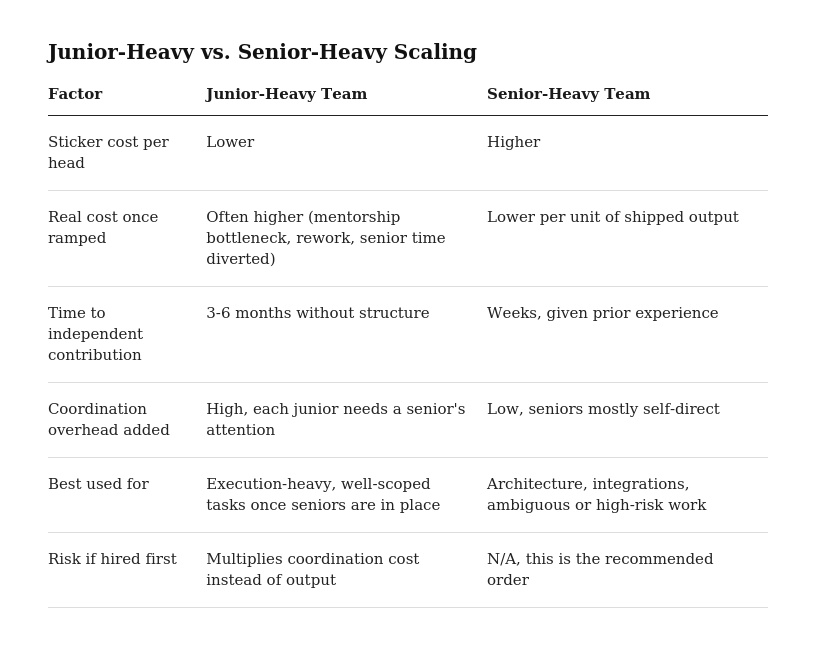
Order matters more than headcount. A team scaling from an early stage should generally hire technical leadership first, then senior owners who can ship independently, then mid-level execution, with headcount tied to a real roadmap rather than a number set in isolation.
The common mistake is hiring the execution layer first because it's cheaper per head. Without senior owners in place to direct them, junior hires multiply coordination cost instead of adding output: more people to unblock, more code to review, more context to transfer, with no one yet in place to absorb that load.
Hire for product fluency, not just technical skill. The most valuable engineers in a scaling org use the product, give feedback unprompted, and reason about how technical decisions affect real users. Not necessarily the most credentialed resume in the stack. Standardized interview rubrics and system design rounds for mid-to-senior roles keep this consistent as more people get involved in hiring.
Don't cut corners to hire fast. A bad hire costs real money. Replacing a mid-level technical role can run well above that role's annual salary once training time, lost productivity, and re-hiring are counted. On a senior engineer, one mis-hire can quietly cost a company a significant fraction of that person's yearly pay. Hiring fast is easy. Hiring right is hard, and the gap between the two gets more expensive as the team grows.
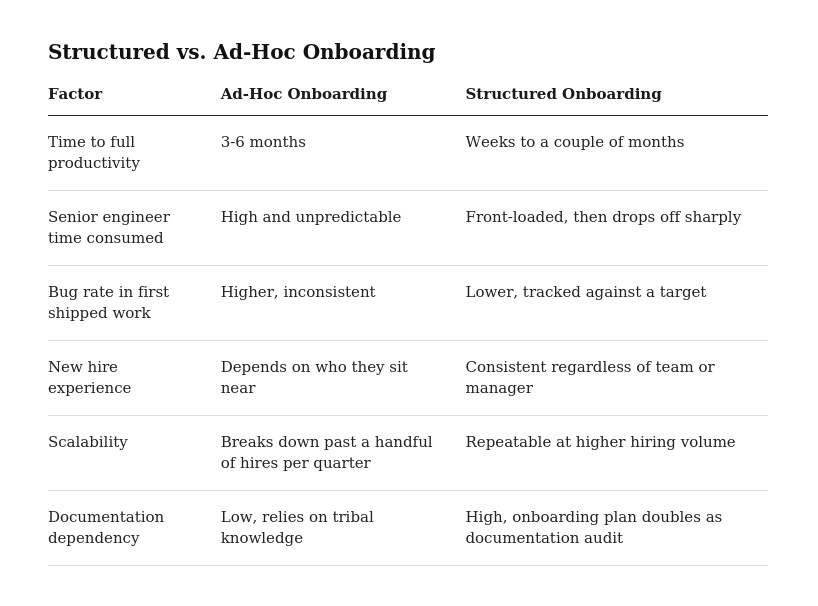
Time to productivity is one of the most underestimated costs in a scaling plan. Without structured onboarding, developers commonly take three to six months to reach full productivity. With a genuinely structured process, that compresses to a fraction of that time. Every month of delay on that ramp is a month of full compensation for partial output.
A workable onboarding structure:
Cutting ramp time by even a couple of months on a senior developer's salary saves tens of thousands of dollars in compensation paid before that person is fully productive, money most scaling budgets never account for because it's hidden inside a salary line, not a separate cost.
Growth without a review structure is where quality erodes fastest. Every addition to the team should tie to a real roadmap milestone, and added velocity should flow through senior review, not around it.
Domain-based team structure helps. Dividing a growing org into smaller squads around clear problem domains creates multiple points of technical leadership instead of funneling every decision through one person. It also cuts meeting load and lowers the bus-factor risk of one person holding critical context, since knowledge sharing increases naturally within a well-scoped domain.
Reserve real capacity for debt, not just features. Teams that actively manage technical debt set aside dedicated capacity for it on an ongoing basis, rather than treating it as something to address "later." Debt that's visible and budgeted stays manageable. Debt that's ignored compounds until it becomes the roadmap.
Track the right signals. Watch whether new engineers are getting meaningfully involved without dragging down response times or support quality, and whether launches are actually landing faster, not just busier. Those indicators tell you whether the team is becoming more capable or just more numerous, and that difference matters more than headcount alone.
One of the more durable lessons from companies that scale well: protect the core team, and add capacity in flexible, well-directed increments rather than permanent headcount for every need. Not every role has to be a full-time internal hire on day one.
This is where a European outstaffing model earns its place in a scaling plan, particularly for roles that create friction when missing but don't require a full-time internal seat immediately: senior QA, DevOps and SRE capacity, and integration engineering are common examples. European teams typically bring:
Used this way, outstaffed capacity isn't a shortcut around hiring discipline. It's a way to apply that same discipline, senior-first, roadmap-tied, review-gated, without forcing every addition through a slower and more expensive full-time hiring cycle.
FactorFull-Time Internal HireEuropean Outstaffed CapacityTime to start contributing47-90+ days to hire, then months to rampDays to weeks, often pre-vetted and senior-leaningCommitment if roadmap shiftsFixed cost, harder to scale downFlexible, scales with the milestone, not a permanent seatBest fitCore product ownership, long-term architecture decisionsSpecialized or capacity-driven roles: QA, DevOps, integrationsTimezone overlapN/A (local)Strong overlap with Western Europe and partial US East CoastReview and quality gatingInternal review processSame internal review process, if structured correctlyRisk of mis-hireHigh cost, slow to unwindLower cost, faster to adjust or replace
Neither column is universally better. The point is matching the engagement type to the actual need. Core, long-term ownership roles usually justify the slower, more expensive path of a full-time hire. Roles tied to a specific milestone or a skill gap that doesn't need a permanent seat are exactly where flexible outstaffed capacity earns its cost advantage.
How do I know if my team is actually ready to scale, versus just under pressure?Look for signs the current team is fully productive and still falling short of delivery demand, not a single bad sprint. If quality is slipping specifically to keep pace with customer growth, that's the clearer signal.
What team size typically triggers a need to restructure?Communication overhead tends to climb sharply once a single team crosses roughly seven to nine people. That's a common point to split into smaller, domain-focused squads rather than keep growing one team indefinitely.
Should I hire junior or senior engineers first when scaling?Senior owners first. Hiring execution-layer talent before senior owners are in place to direct them tends to multiply coordination cost rather than add real output.
How much should I budget for onboarding time when scaling?Plan for reduced productivity during the first one to two months for any new hire, even a strong one. Structured onboarding programs meaningfully compress this compared to ad-hoc approaches, but the ramp period itself is real and worth budgeting for.
Is outstaffed European talent a good fit for scaling specialized roles?Yes, particularly for roles like DevOps, QA, and integration engineering that create friction when understaffed but don't necessarily need a full-time internal hire immediately. Strong timezone overlap keeps this talent inside your real-time collaboration loop rather than working purely async.
Scaling an engineering team well isn't about hitting a headcount number. It's about timing growth to a real signal, hiring in the right order, fixing onboarding before you scale it, and keeping review discipline in place as more people touch the product. Teams that get this right don't just grow bigger. They stay fast.
If you're planning your next phase of engineering growth and want to talk through where flexible, senior-leaning European capacity could take pressure off your core team without adding permanent headcount, we're happy to walk through it. No pressure, just a straight conversation about what your roadmap actually needs.

A company sets out to hire 20 engineers in 90 days. It hits the number. Within weeks, production bugs pile up, sprints turn chaotic, and senior developers spend more time onboarding new hires than shipping their own work.
That wasn't a hiring problem. It was a scaling problem, and it's one of the most common ways fast-growing companies quietly damage the product they're trying to accelerate.
Scaling an engineering team isn't like scaling a sales team. Software development is collaborative work, and adding people doesn't produce proportional output. Fred Brooks made this point decades ago: more engineers can slow a team down before they speed it up. This guide covers how to grow a team in 2026 without losing the code quality, velocity, and culture that made the original team work.
The biggest scaling mistake isn't hiring too fast. It's hiring in response to the wrong signal.
Scale when your current team is fully productive and still can't meet delivery demand, not when you're behind on one sprint. The real signs: senior engineers spend more time unblocking others than shipping their own work, and the roadmap keeps slipping regardless. Or customer growth is outpacing delivery capacity and quality is starting to slip just to keep up.
There's also a structural signal worth watching. Once a single team grows past roughly seven to nine people, communication overhead climbs and velocity drops. That's usually a cue to split the team, not add to it. If you're not sure whether you've actually hit the wall, treat that uncertainty as a reason to wait.
Run through this before opening a single requisition. If more than one or two items are unchecked, fix those first. Hiring on top of them just scales the problem.
Code quality. At five engineers, everyone knows everything, decisions happen in hallway conversations, and quality holds together through shared context and mutual accountability. At fifty, those patterns stop working. Communication paths multiply, context fragments across teams, and quality starts depending on process instead of personal relationships. Technical debt is the clearest casualty: a large share of engineering teams report a rise in technical debt during rapid scaling, and it builds up quietly while leadership is focused on headcount.
Whatever made the early team good. Harder to name, just as real. The shared context, the fast decisions, the informal trust that let a small team move without much process. Protecting both code quality and culture means keeping the core in-house and adding capacity in small, well-directed increments rather than bringing in a wave of new hires at once.
Invest in automation early. CI, automated testing, and deployment automation reduce scaling friction directly. Every manual process eliminated before growth is one less thing that breaks under new headcount, and automated tests matter more, not less, once more people are touching the same codebase.
Consolidate your tooling. Fragmented toolchains cost real time. Engineers can lose a meaningful share of their week navigating tool complexity, and that cost grows as the team grows and more people move between systems. Tool consolidation is one of the highest-leverage moves available for protecting flow during rapid growth.
Treat documentation as infrastructure. Companies that scale well while staying remote or distributed treat documentation as the operating system of the engineering org, not a nice-to-have. Without it, every new hire relies on tapping a senior engineer's shoulder, which is exactly the bottleneck you're trying to avoid.
Order matters more than headcount. A team scaling from an early stage should generally hire technical leadership first, then senior owners who can ship independently, then mid-level execution, with headcount tied to a real roadmap rather than a number set in isolation.
The common mistake is hiring the execution layer first because it's cheaper per head. Without senior owners in place to direct them, junior hires multiply coordination cost instead of adding output: more people to unblock, more code to review, more context to transfer, with no one yet in place to absorb that load.
Hire for product fluency, not just technical skill. The most valuable engineers in a scaling org use the product, give feedback unprompted, and reason about how technical decisions affect real users. Not necessarily the most credentialed resume in the stack. Standardized interview rubrics and system design rounds for mid-to-senior roles keep this consistent as more people get involved in hiring.
Don't cut corners to hire fast. A bad hire costs real money. Replacing a mid-level technical role can run well above that role's annual salary once training time, lost productivity, and re-hiring are counted. On a senior engineer, one mis-hire can quietly cost a company a significant fraction of that person's yearly pay. Hiring fast is easy. Hiring right is hard, and the gap between the two gets more expensive as the team grows.
Time to productivity is one of the most underestimated costs in a scaling plan. Without structured onboarding, developers commonly take three to six months to reach full productivity. With a genuinely structured process, that compresses to a fraction of that time. Every month of delay on that ramp is a month of full compensation for partial output.
A workable onboarding structure:
Cutting ramp time by even a couple of months on a senior developer's salary saves tens of thousands of dollars in compensation paid before that person is fully productive, money most scaling budgets never account for because it's hidden inside a salary line, not a separate cost.
Growth without a review structure is where quality erodes fastest. Every addition to the team should tie to a real roadmap milestone, and added velocity should flow through senior review, not around it.
Domain-based team structure helps. Dividing a growing org into smaller squads around clear problem domains creates multiple points of technical leadership instead of funneling every decision through one person. It also cuts meeting load and lowers the bus-factor risk of one person holding critical context, since knowledge sharing increases naturally within a well-scoped domain.
Reserve real capacity for debt, not just features. Teams that actively manage technical debt set aside dedicated capacity for it on an ongoing basis, rather than treating it as something to address "later." Debt that's visible and budgeted stays manageable. Debt that's ignored compounds until it becomes the roadmap.
Track the right signals. Watch whether new engineers are getting meaningfully involved without dragging down response times or support quality, and whether launches are actually landing faster, not just busier. Those indicators tell you whether the team is becoming more capable or just more numerous, and that difference matters more than headcount alone.
One of the more durable lessons from companies that scale well: protect the core team, and add capacity in flexible, well-directed increments rather than permanent headcount for every need. Not every role has to be a full-time internal hire on day one.
This is where a European outstaffing model earns its place in a scaling plan, particularly for roles that create friction when missing but don't require a full-time internal seat immediately: senior QA, DevOps and SRE capacity, and integration engineering are common examples. European teams typically bring:
Used this way, outstaffed capacity isn't a shortcut around hiring discipline. It's a way to apply that same discipline, senior-first, roadmap-tied, review-gated, without forcing every addition through a slower and more expensive full-time hiring cycle.
FactorFull-Time Internal HireEuropean Outstaffed CapacityTime to start contributing47-90+ days to hire, then months to rampDays to weeks, often pre-vetted and senior-leaningCommitment if roadmap shiftsFixed cost, harder to scale downFlexible, scales with the milestone, not a permanent seatBest fitCore product ownership, long-term architecture decisionsSpecialized or capacity-driven roles: QA, DevOps, integrationsTimezone overlapN/A (local)Strong overlap with Western Europe and partial US East CoastReview and quality gatingInternal review processSame internal review process, if structured correctlyRisk of mis-hireHigh cost, slow to unwindLower cost, faster to adjust or replace
Neither column is universally better. The point is matching the engagement type to the actual need. Core, long-term ownership roles usually justify the slower, more expensive path of a full-time hire. Roles tied to a specific milestone or a skill gap that doesn't need a permanent seat are exactly where flexible outstaffed capacity earns its cost advantage.
How do I know if my team is actually ready to scale, versus just under pressure?Look for signs the current team is fully productive and still falling short of delivery demand, not a single bad sprint. If quality is slipping specifically to keep pace with customer growth, that's the clearer signal.
What team size typically triggers a need to restructure?Communication overhead tends to climb sharply once a single team crosses roughly seven to nine people. That's a common point to split into smaller, domain-focused squads rather than keep growing one team indefinitely.
Should I hire junior or senior engineers first when scaling?Senior owners first. Hiring execution-layer talent before senior owners are in place to direct them tends to multiply coordination cost rather than add real output.
How much should I budget for onboarding time when scaling?Plan for reduced productivity during the first one to two months for any new hire, even a strong one. Structured onboarding programs meaningfully compress this compared to ad-hoc approaches, but the ramp period itself is real and worth budgeting for.
Is outstaffed European talent a good fit for scaling specialized roles?Yes, particularly for roles like DevOps, QA, and integration engineering that create friction when understaffed but don't necessarily need a full-time internal hire immediately. Strong timezone overlap keeps this talent inside your real-time collaboration loop rather than working purely async.
Scaling an engineering team well isn't about hitting a headcount number. It's about timing growth to a real signal, hiring in the right order, fixing onboarding before you scale it, and keeping review discipline in place as more people touch the product. Teams that get this right don't just grow bigger. They stay fast.
If you're planning your next phase of engineering growth and want to talk through where flexible, senior-leaning European capacity could take pressure off your core team without adding permanent headcount, we're happy to walk through it. No pressure, just a straight conversation about what your roadmap actually needs.
.svg)


.svg)