.jpg)
Almost every engineering leader now has an AI mandate. Far fewer have the team to deliver it. If you've tried to hire AI engineers in the past year, you know the pattern: months of searching, candidates with impressive research credentials but little production experience, and offers that get outbid before the paperwork is signed.
Scarcity is only part of the problem. Many companies hire for the wrong role, test for the wrong skills, and default to hiring models that don't match how AI work actually gets done.
This guide covers what's driving the AI talent shortage, how to identify the AI role you actually need, how to vet engineers for production work rather than demos, and why Eastern Europe has become one of the most reliable sources of senior AI and machine learning talent for US and European teams.
LinkedIn's 2025 Jobs on the Rise report ranked AI engineer as the fastest-growing job title in the US. The World Economic Forum's Future of Jobs Report 2025 placed AI and machine learning specialists among the fastest-growing roles worldwide.
Every industry, from fintech to logistics to healthcare, is now competing for the same small pool of people who have shipped AI systems in production. That pool grows far more slowly than demand.
In major US tech hubs, senior machine learning engineers routinely command $180,000 to $250,000 or more in base salary, before equity and bonuses. Frontier AI labs and big tech pay well above that, which pulls the entire market upward.
For a startup or mid-market company, a single senior AI hire can consume a large share of the annual engineering budget. That makes every hiring mistake expensive.
Specialist AI roles often take three to six months to fill through traditional recruiting. In a field where tooling changes every quarter, that delay has a real cost. By the time a new hire is onboarded, a competitor who started at the same time may already have a product in customers' hands.
Gartner predicted that at least 30% of generative AI projects would be abandoned after proof of concept by the end of 2025, citing poor data quality, escalating costs and unclear business value.
Talent is a large part of that story. Teams that can build a convincing demo often lack the engineering discipline to make it reliable, affordable and secure at scale.
Takeaway: The AI talent shortage is real, but the bigger risk is spending months and a premium salary on the wrong hire.
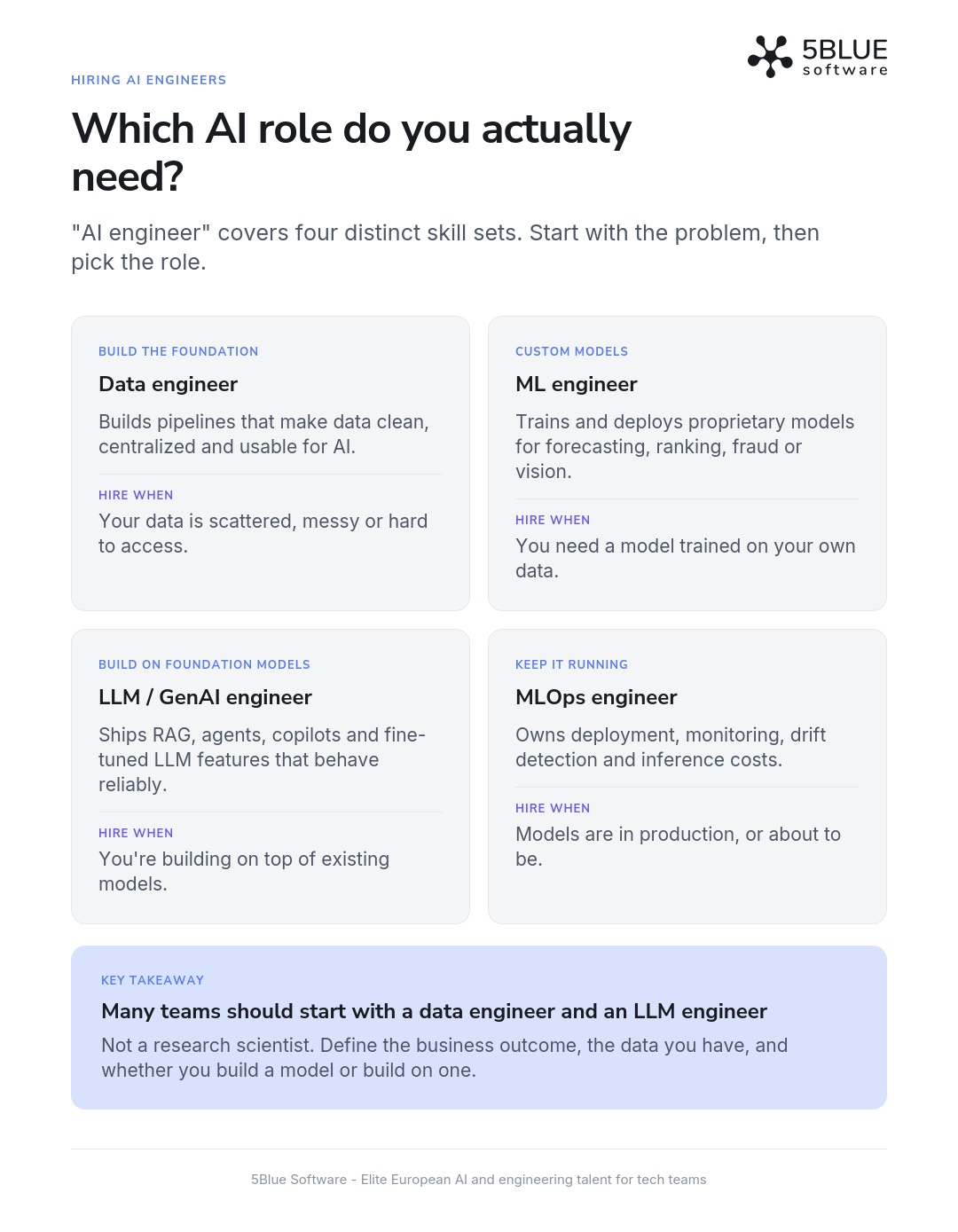
"AI engineer" has become a catch-all title. In practice, it covers several distinct skill sets, and hiring the wrong one is among the most common and costly mistakes companies make.
If your data is scattered across systems, inconsistently labeled or hard to access, this is your first hire. Data preparation is widely estimated to consume the majority of time on AI projects. No model will outperform the quality of the pipeline feeding it.
Hire when: you have AI ambitions, but your data isn't clean, centralized or reliably accessible.
ML engineers build, train and deploy custom models for recommendation, forecasting, fraud detection, computer vision or ranking. They sit between data science and software engineering. They're most valuable when your problem is specific to your data and off-the-shelf models won't solve it.
Hire when: you need a proprietary model trained on your own data to solve a defined prediction problem.
This is the fastest-growing category. These engineers build products on top of foundation models using retrieval-augmented generation (RAG), agents, fine-tuning and evaluation frameworks. Their core skill isn't training models from scratch. It's making large language models behave reliably inside real products.
Hire when: you're building copilots, assistants, document processing, search or agentic workflows on top of existing models.
An MLOps engineer keeps models running in production. They own deployment, monitoring, versioning, drift detection, cost control and infrastructure. Without them, models degrade quietly and cloud bills climb fast.
Hire when: you have models in production, or soon will, and need them to stay accurate, fast and affordable.
Before writing a job description, write down three things: the business outcome, the data you have, and whether you need to build a model or build on top of one. That usually makes the right role obvious.
Many teams find that their first two hires should be a data engineer and an LLM engineer, not a research scientist with a PhD.
Takeaway: Define the problem first. The right first hire is often less glamorous, and far more useful, than a research-heavy generalist.
Most interview processes for AI roles borrow from either academic research or generic software engineering. Neither tells you much about whether a candidate can ship AI that works for real users. Here's what to test instead.
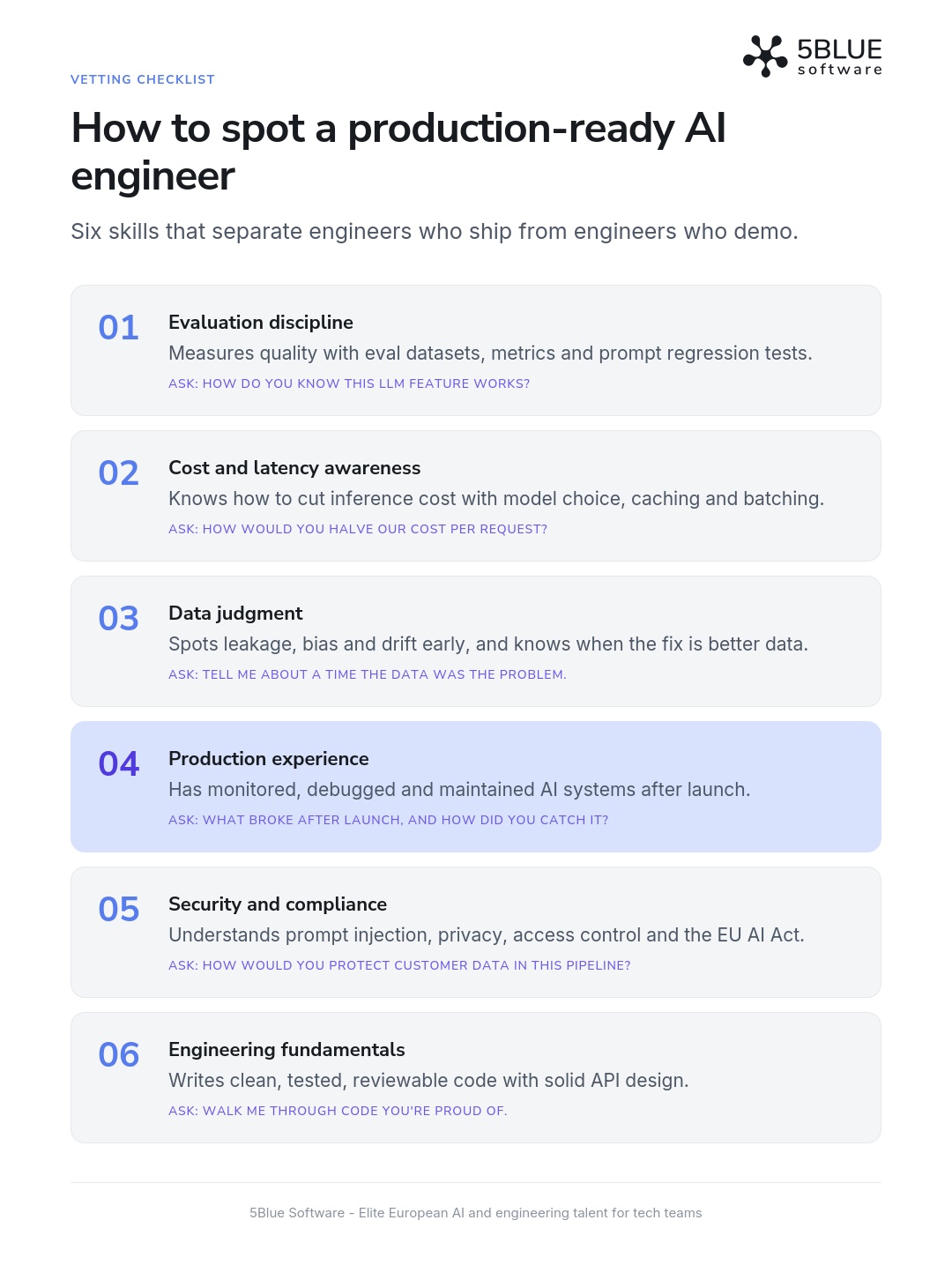
Ask how they measure whether a model or LLM feature actually works. Strong candidates talk about evaluation datasets, offline and online metrics, regression tests for prompts and human review loops. Weak ones say it "looked good in testing."
A feature that costs $2 per request or takes eight seconds to respond won't survive contact with users. Look for engineers who can discuss model selection trade-offs, caching, batching and smaller distilled models, and who can explain how they'd bring inference costs down.
Ask about a time the data was the problem. Good AI engineers spot leakage, bias, label noise and distribution shift early. They also know when the fix is better data rather than a bigger model.
Probe what happened after launch. How did they monitor the system? What broke? How did they detect drift or hallucinations? Anyone can build a notebook demo. Far fewer have kept a model healthy in production for a year.
The EU AI Act is phasing in obligations through 2026 and 2027, and data protection rules are tightening globally. Engineers need to understand prompt injection, data privacy, access control and audit trails, especially if your systems touch customer data.
AI code is still code. Test for clean architecture, testing habits, code review skills and API design. The best AI engineers are strong software engineers first.
A four-stage process works well for most teams. Start with a 30-minute conversation about a system the candidate shipped end to end. Follow with a realistic exercise from your domain, such as improving a weak RAG pipeline. Then run a system design session focused on scale, cost and monitoring. Finish with a short review of code they've written or reviewed.
This takes less time than a typical five-round loop, and it tells you far more about how someone will perform on your team.
Takeaway: Hire for production judgment. Research credentials are a bonus, not a proxy for the ability to ship.
When companies can't find AI engineers locally, many default to the cheapest offshore option. Experienced CTOs increasingly look to Eastern Europe instead, and cost isn't the main reason.
Poland, Romania, Ukraine, Czechia, Bulgaria and their neighbors together employ well over a million software professionals, by most industry estimates. The region has a long tradition of mathematics, physics and computer science education, and its engineers consistently place near the top of international programming and algorithm competitions.
That foundation matters in AI. Strong mathematical intuition is what separates engineers who understand models from those who only call APIs.
The region doesn't just supply talent. It builds AI companies. UiPath, one of the best-known names in automation, was founded in Bucharest. ElevenLabs, a leader in AI voice technology, was founded by Polish engineers. Grammarly started in Kyiv.
At the frontier, OpenAI co-founder Wojciech Zaremba and chief scientist Jakub Pachocki both come from Poland. Research institutes such as INSAIT in Sofia and IDEAS NCBR in Warsaw are building serious AI research capacity inside the region.
Most of the region sits inside the European Union. That means familiar legal frameworks, strong IP protection and GDPR compliance by default. For AI work involving customer data, this removes a major source of legal and security friction that companies often face with more distant markets.
It also means Eastern European AI developers already work within the regulatory environment shaped by the EU AI Act, which is increasingly relevant for any company selling into Europe.
Eastern European teams share most or all of the working day with Western Europe and have a practical three-to-six-hour overlap with the US East Coast. That's enough for daily standups, pairing sessions and real-time decisions. It matters for AI work, where priorities often shift weekly as you learn from the data.
Senior AI and ML engineers in Eastern Europe typically cost significantly less than equivalents in the US, UK or Germany. The goal isn't to hire cheaper engineers. It's to hire more senior engineers for the same budget, or to build a complete team covering data, ML and MLOps for roughly what one senior US hire would cost.
Many Eastern European engineers have spent years embedded in product teams at Western companies. They're comfortable with English-language documentation, agile rituals and direct feedback, and they're used to owning outcomes rather than closing tickets.
Takeaway: Eastern Europe offers the combination most AI teams need: technical depth, proven AI output, EU-grade compliance and genuine working-hours overlap.
Once you know which roles you need, the next decision is how to engage them. Each model has its place.
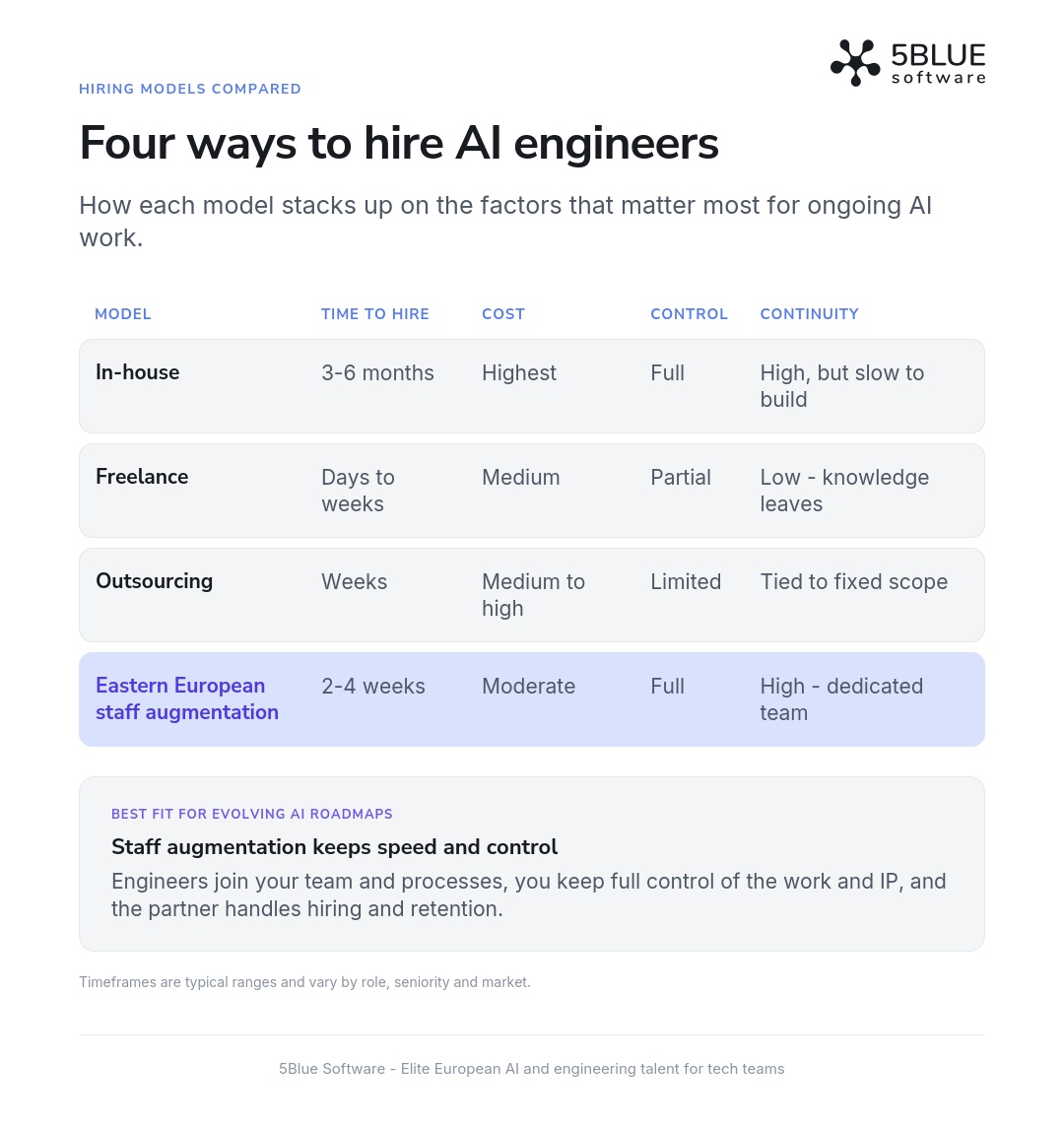
In-house hiring suits long-term core roles when you can afford both the wait and the salary. You get full control and cultural integration, but you carry the highest cost and the longest time-to-hire.
Freelancers work well for short, tightly scoped tasks such as a proof of concept or a model audit. The risk is continuity. Freelancers move on, knowledge leaves with them, and managing security and IP can be harder.
With outsourcing, a vendor delivers a defined outcome. This can work for self-contained projects, but you give up day-to-day control. AI work also rarely stays neatly scoped. Requirements evolve as you learn from the data, and fixed-scope contracts handle that poorly.
With AI staff augmentation, dedicated engineers join your team, work in your tools and processes, and report to your leads. The partner handles recruiting, contracts, payroll and retention.
You keep full control of the work and the IP, and you can typically add senior engineers within weeks instead of months. For AI teams, where direction changes fast and domain knowledge compounds over time, this is often the most practical middle ground.
Takeaway: Match the model to the work. For ongoing AI development where speed and control both matter, staff augmentation with Eastern European engineers is often the strongest fit.
Hiring a researcher to build a product. Research scientists are invaluable for novel model work. Most companies, though, need engineers who can integrate, evaluate and ship.
Skipping data engineering. If your data isn't ready, your AI hire will spend their first six months doing data work at a machine learning salary.
Testing puzzles instead of AI judgment. Generic algorithm tests say little about evaluation discipline, cost awareness or production experience. Use realistic problems from your own domain.
Ignoring MLOps until something breaks. Models drift, costs spike and quality drops quietly. Plan for monitoring and infrastructure from day one.
Expecting one person to be a whole team. AI systems need data, modeling, infrastructure and product work. A single "AI person" can't cover all of it well, and burnout follows quickly.
The companies moving fastest with AI aren't necessarily those with the biggest budgets. They're the ones that define the problem clearly, hire for the right role, vet for production skills and choose a hiring model that matches how AI work evolves.
If you need to hire AI engineers and the local market is too slow or too expensive, widening your search to Eastern Europe gives you access to deep technical talent, proven AI experience and EU-grade compliance, all within your working day.
If you're evaluating options, 5Blue Software can help you map the roles your AI roadmap needs and introduce you to vetted senior engineers from across Eastern Europe, usually within a few weeks. Talk to our team to see what that could look like for you.
In major US tech hubs, senior AI and machine learning engineers often earn $180,000 to $250,000 or more in base salary, plus equity and benefits. Senior engineers in Eastern Europe typically cost significantly less, which lets companies build a full AI team for a similar budget.
Through traditional recruiting, specialist AI roles often take three to six months to fill. With staff augmentation, companies can usually add vetted senior engineers within a few weeks.
A machine learning engineer typically builds and trains custom models on company data. "AI engineer" is broader and often refers to engineers who build products on top of large language models using techniques like RAG, agents and fine-tuning.
Eastern Europe combines a large, highly educated engineering workforce with a track record of building successful AI companies. Most countries in the region are EU members, which simplifies contracts, IP protection and GDPR compliance. The region also offers strong timezone overlap with Western Europe and the US East Coast.
Yes. With staff augmentation, engineers work in your tools, attend your standups and report to your engineering leads. You keep full control of priorities, processes and IP, while the partner handles recruiting, contracts and retention.

Almost every engineering leader now has an AI mandate. Far fewer have the team to deliver it. If you've tried to hire AI engineers in the past year, you know the pattern: months of searching, candidates with impressive research credentials but little production experience, and offers that get outbid before the paperwork is signed.
Scarcity is only part of the problem. Many companies hire for the wrong role, test for the wrong skills, and default to hiring models that don't match how AI work actually gets done.
This guide covers what's driving the AI talent shortage, how to identify the AI role you actually need, how to vet engineers for production work rather than demos, and why Eastern Europe has become one of the most reliable sources of senior AI and machine learning talent for US and European teams.
LinkedIn's 2025 Jobs on the Rise report ranked AI engineer as the fastest-growing job title in the US. The World Economic Forum's Future of Jobs Report 2025 placed AI and machine learning specialists among the fastest-growing roles worldwide.
Every industry, from fintech to logistics to healthcare, is now competing for the same small pool of people who have shipped AI systems in production. That pool grows far more slowly than demand.
In major US tech hubs, senior machine learning engineers routinely command $180,000 to $250,000 or more in base salary, before equity and bonuses. Frontier AI labs and big tech pay well above that, which pulls the entire market upward.
For a startup or mid-market company, a single senior AI hire can consume a large share of the annual engineering budget. That makes every hiring mistake expensive.
Specialist AI roles often take three to six months to fill through traditional recruiting. In a field where tooling changes every quarter, that delay has a real cost. By the time a new hire is onboarded, a competitor who started at the same time may already have a product in customers' hands.
Gartner predicted that at least 30% of generative AI projects would be abandoned after proof of concept by the end of 2025, citing poor data quality, escalating costs and unclear business value.
Talent is a large part of that story. Teams that can build a convincing demo often lack the engineering discipline to make it reliable, affordable and secure at scale.
Takeaway: The AI talent shortage is real, but the bigger risk is spending months and a premium salary on the wrong hire.
"AI engineer" has become a catch-all title. In practice, it covers several distinct skill sets, and hiring the wrong one is among the most common and costly mistakes companies make.
If your data is scattered across systems, inconsistently labeled or hard to access, this is your first hire. Data preparation is widely estimated to consume the majority of time on AI projects. No model will outperform the quality of the pipeline feeding it.
Hire when: you have AI ambitions, but your data isn't clean, centralized or reliably accessible.
ML engineers build, train and deploy custom models for recommendation, forecasting, fraud detection, computer vision or ranking. They sit between data science and software engineering. They're most valuable when your problem is specific to your data and off-the-shelf models won't solve it.
Hire when: you need a proprietary model trained on your own data to solve a defined prediction problem.
This is the fastest-growing category. These engineers build products on top of foundation models using retrieval-augmented generation (RAG), agents, fine-tuning and evaluation frameworks. Their core skill isn't training models from scratch. It's making large language models behave reliably inside real products.
Hire when: you're building copilots, assistants, document processing, search or agentic workflows on top of existing models.
An MLOps engineer keeps models running in production. They own deployment, monitoring, versioning, drift detection, cost control and infrastructure. Without them, models degrade quietly and cloud bills climb fast.
Hire when: you have models in production, or soon will, and need them to stay accurate, fast and affordable.
Before writing a job description, write down three things: the business outcome, the data you have, and whether you need to build a model or build on top of one. That usually makes the right role obvious.
Many teams find that their first two hires should be a data engineer and an LLM engineer, not a research scientist with a PhD.
Takeaway: Define the problem first. The right first hire is often less glamorous, and far more useful, than a research-heavy generalist.
Most interview processes for AI roles borrow from either academic research or generic software engineering. Neither tells you much about whether a candidate can ship AI that works for real users. Here's what to test instead.
Ask how they measure whether a model or LLM feature actually works. Strong candidates talk about evaluation datasets, offline and online metrics, regression tests for prompts and human review loops. Weak ones say it "looked good in testing."
A feature that costs $2 per request or takes eight seconds to respond won't survive contact with users. Look for engineers who can discuss model selection trade-offs, caching, batching and smaller distilled models, and who can explain how they'd bring inference costs down.
Ask about a time the data was the problem. Good AI engineers spot leakage, bias, label noise and distribution shift early. They also know when the fix is better data rather than a bigger model.
Probe what happened after launch. How did they monitor the system? What broke? How did they detect drift or hallucinations? Anyone can build a notebook demo. Far fewer have kept a model healthy in production for a year.
The EU AI Act is phasing in obligations through 2026 and 2027, and data protection rules are tightening globally. Engineers need to understand prompt injection, data privacy, access control and audit trails, especially if your systems touch customer data.
AI code is still code. Test for clean architecture, testing habits, code review skills and API design. The best AI engineers are strong software engineers first.
A four-stage process works well for most teams. Start with a 30-minute conversation about a system the candidate shipped end to end. Follow with a realistic exercise from your domain, such as improving a weak RAG pipeline. Then run a system design session focused on scale, cost and monitoring. Finish with a short review of code they've written or reviewed.
This takes less time than a typical five-round loop, and it tells you far more about how someone will perform on your team.
Takeaway: Hire for production judgment. Research credentials are a bonus, not a proxy for the ability to ship.
When companies can't find AI engineers locally, many default to the cheapest offshore option. Experienced CTOs increasingly look to Eastern Europe instead, and cost isn't the main reason.
Poland, Romania, Ukraine, Czechia, Bulgaria and their neighbors together employ well over a million software professionals, by most industry estimates. The region has a long tradition of mathematics, physics and computer science education, and its engineers consistently place near the top of international programming and algorithm competitions.
That foundation matters in AI. Strong mathematical intuition is what separates engineers who understand models from those who only call APIs.
The region doesn't just supply talent. It builds AI companies. UiPath, one of the best-known names in automation, was founded in Bucharest. ElevenLabs, a leader in AI voice technology, was founded by Polish engineers. Grammarly started in Kyiv.
At the frontier, OpenAI co-founder Wojciech Zaremba and chief scientist Jakub Pachocki both come from Poland. Research institutes such as INSAIT in Sofia and IDEAS NCBR in Warsaw are building serious AI research capacity inside the region.
Most of the region sits inside the European Union. That means familiar legal frameworks, strong IP protection and GDPR compliance by default. For AI work involving customer data, this removes a major source of legal and security friction that companies often face with more distant markets.
It also means Eastern European AI developers already work within the regulatory environment shaped by the EU AI Act, which is increasingly relevant for any company selling into Europe.
Eastern European teams share most or all of the working day with Western Europe and have a practical three-to-six-hour overlap with the US East Coast. That's enough for daily standups, pairing sessions and real-time decisions. It matters for AI work, where priorities often shift weekly as you learn from the data.
Senior AI and ML engineers in Eastern Europe typically cost significantly less than equivalents in the US, UK or Germany. The goal isn't to hire cheaper engineers. It's to hire more senior engineers for the same budget, or to build a complete team covering data, ML and MLOps for roughly what one senior US hire would cost.
Many Eastern European engineers have spent years embedded in product teams at Western companies. They're comfortable with English-language documentation, agile rituals and direct feedback, and they're used to owning outcomes rather than closing tickets.
Takeaway: Eastern Europe offers the combination most AI teams need: technical depth, proven AI output, EU-grade compliance and genuine working-hours overlap.
Once you know which roles you need, the next decision is how to engage them. Each model has its place.
In-house hiring suits long-term core roles when you can afford both the wait and the salary. You get full control and cultural integration, but you carry the highest cost and the longest time-to-hire.
Freelancers work well for short, tightly scoped tasks such as a proof of concept or a model audit. The risk is continuity. Freelancers move on, knowledge leaves with them, and managing security and IP can be harder.
With outsourcing, a vendor delivers a defined outcome. This can work for self-contained projects, but you give up day-to-day control. AI work also rarely stays neatly scoped. Requirements evolve as you learn from the data, and fixed-scope contracts handle that poorly.
With AI staff augmentation, dedicated engineers join your team, work in your tools and processes, and report to your leads. The partner handles recruiting, contracts, payroll and retention.
You keep full control of the work and the IP, and you can typically add senior engineers within weeks instead of months. For AI teams, where direction changes fast and domain knowledge compounds over time, this is often the most practical middle ground.
Takeaway: Match the model to the work. For ongoing AI development where speed and control both matter, staff augmentation with Eastern European engineers is often the strongest fit.
Hiring a researcher to build a product. Research scientists are invaluable for novel model work. Most companies, though, need engineers who can integrate, evaluate and ship.
Skipping data engineering. If your data isn't ready, your AI hire will spend their first six months doing data work at a machine learning salary.
Testing puzzles instead of AI judgment. Generic algorithm tests say little about evaluation discipline, cost awareness or production experience. Use realistic problems from your own domain.
Ignoring MLOps until something breaks. Models drift, costs spike and quality drops quietly. Plan for monitoring and infrastructure from day one.
Expecting one person to be a whole team. AI systems need data, modeling, infrastructure and product work. A single "AI person" can't cover all of it well, and burnout follows quickly.
The companies moving fastest with AI aren't necessarily those with the biggest budgets. They're the ones that define the problem clearly, hire for the right role, vet for production skills and choose a hiring model that matches how AI work evolves.
If you need to hire AI engineers and the local market is too slow or too expensive, widening your search to Eastern Europe gives you access to deep technical talent, proven AI experience and EU-grade compliance, all within your working day.
If you're evaluating options, 5Blue Software can help you map the roles your AI roadmap needs and introduce you to vetted senior engineers from across Eastern Europe, usually within a few weeks. Talk to our team to see what that could look like for you.
In major US tech hubs, senior AI and machine learning engineers often earn $180,000 to $250,000 or more in base salary, plus equity and benefits. Senior engineers in Eastern Europe typically cost significantly less, which lets companies build a full AI team for a similar budget.
Through traditional recruiting, specialist AI roles often take three to six months to fill. With staff augmentation, companies can usually add vetted senior engineers within a few weeks.
A machine learning engineer typically builds and trains custom models on company data. "AI engineer" is broader and often refers to engineers who build products on top of large language models using techniques like RAG, agents and fine-tuning.
Eastern Europe combines a large, highly educated engineering workforce with a track record of building successful AI companies. Most countries in the region are EU members, which simplifies contracts, IP protection and GDPR compliance. The region also offers strong timezone overlap with Western Europe and the US East Coast.
Yes. With staff augmentation, engineers work in your tools, attend your standups and report to your engineering leads. You keep full control of priorities, processes and IP, while the partner handles recruiting, contracts and retention.
.svg)


.svg)