.jpg)
If you are working out how to vet remote developers in 2026, most of the old signals no longer mean much. A take-home test can go into an AI assistant and come back as clean, commented code in twenty minutes. Live coding rounds are not much safer, because overlay tools can read the question from the screen and suggest an answer in real time.
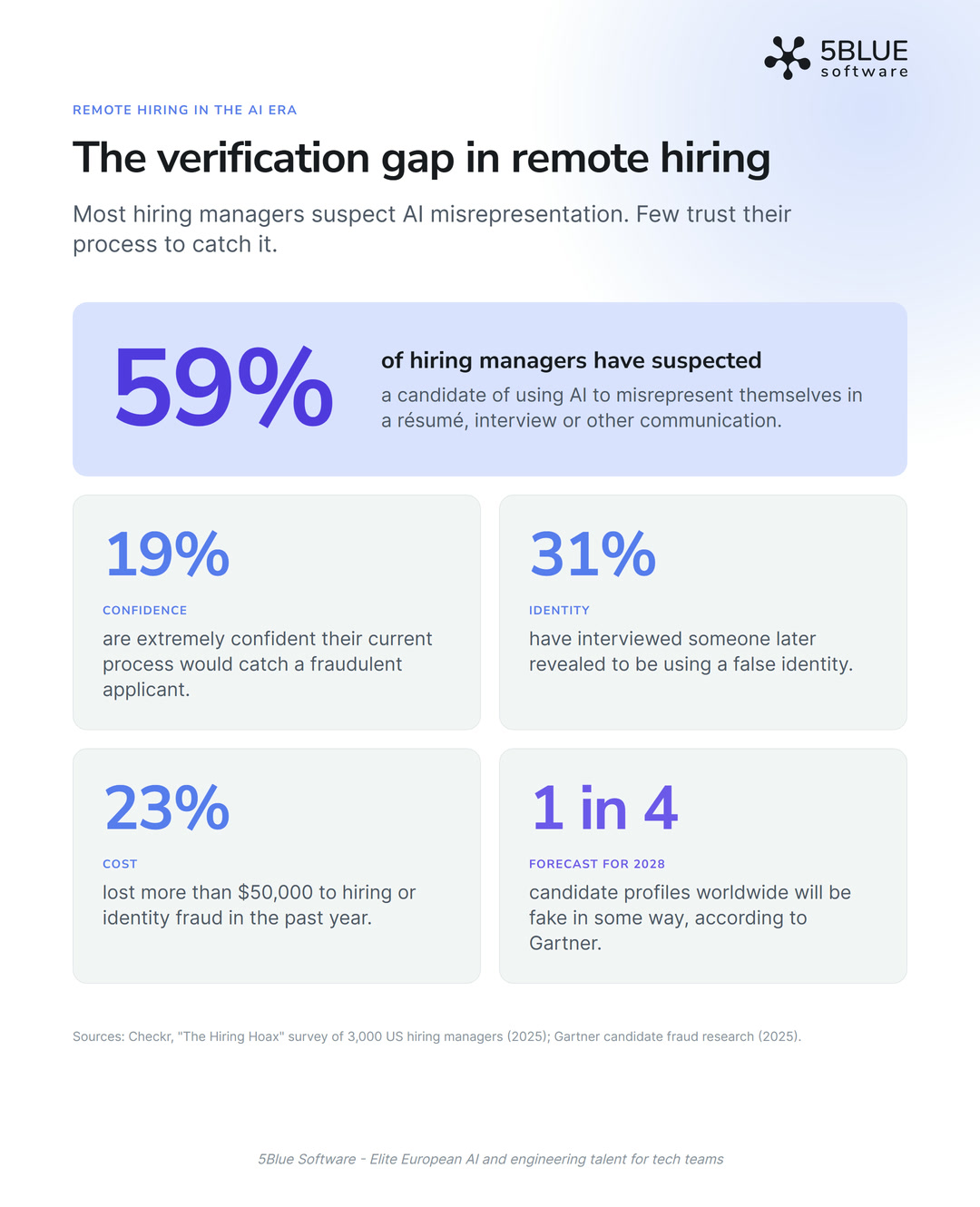
Hiring managers have noticed. In Checkr's 2025 survey of 3,000 US hiring managers, 59% said they had suspected a candidate of using AI to misrepresent themselves. Only 19% were extremely confident that their process would catch a fraudulent applicant.
This guide covers the two separate problems you are solving, the policy decision to make before anything else, a five-stage vetting process, and the signals that matter compared with the ones that unfairly screen out good engineers.
Most advice on AI cheating in technical interviews treats it as a single issue. In practice you are dealing with two, and each needs a different defense.
This candidate is a real person using their real identity. They use AI during the interview to cover gaps in their knowledge. The risk is a hire who performs well in a 60-minute round and then struggles on a real codebase. The defense is interview design: ask for work that AI cannot do on the candidate's behalf, such as explaining decisions, defending trade-offs and adapting when requirements change.
In this case the person on the call is not the person you will employ, or that person does not exist. Gartner predicts that by 2028, one in four candidate profiles worldwide will be fake. In the same Checkr survey, 31% of hiring managers said they had interviewed someone who was later revealed to be using a false identity. In January 2025, the FBI warned that fake remote IT workers had escalated from collecting salaries to stealing source code and extorting employers.
The defense here is verification, and interview questions will not provide it.
Takeaway: a better coding question will not stop a stand-in, and an ID check will not reveal someone who cannot code without an assistant. Your process needs both.
Before you change a single interview question, decide what you are actually testing for. Companies tend to choose one of three policies:
Our recommendation is to match the policy to the job. If your engineers use Copilot, Cursor or Claude every day, banning AI in the interview measures a job that does not exist.
Whichever policy you choose, write it into the interview invitation. A clear rule turns "cheating" into a policy breach you can act on. It also means honest candidates are not disadvantaged against those who break a rule nobody stated.
Takeaway: an AI-assisted coding interview is fair only when every candidate knows the rules in advance.
The process below addresses both problems. Each stage checks something the others cannot, so a candidate would have to fake all five consistently to get through.
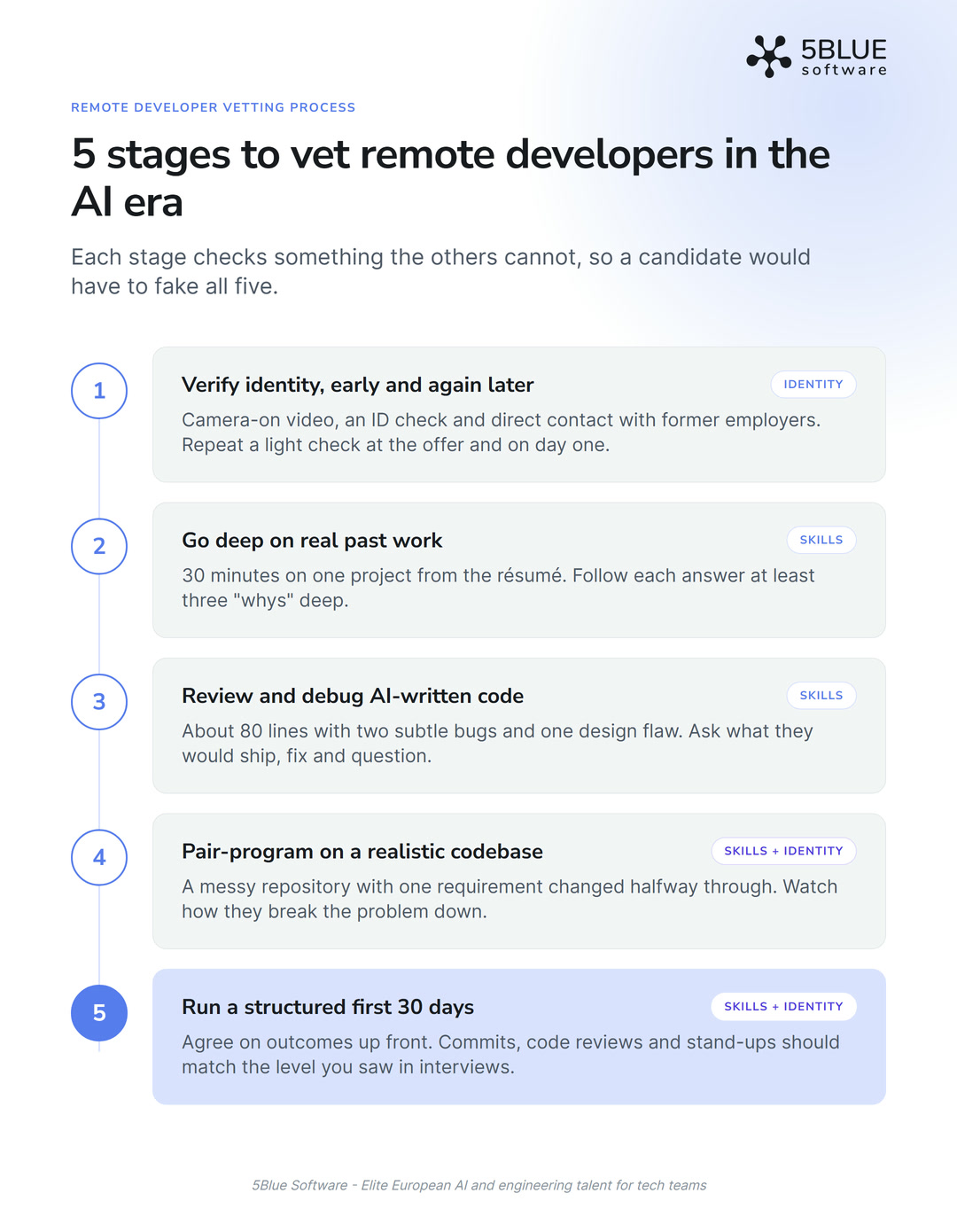
Start with a live video call with the camera on, and match a government ID through a verification service. Check that the candidate's work history is consistent across their résumé, LinkedIn and GitHub. Following FBI guidance, contact former employers through the company's official channels rather than numbers the candidate provides. Repeat a light check at the offer stage and on day one, so you know the person who starts is the person you interviewed.
Spend 30 minutes on one project from the candidate's résumé. Ask why they chose that database, what broke in production and what they would change now. Follow each answer at least three levels deep. AI can produce a plausible first answer, but it struggles to keep a consistent story through the fourth "why" about a system only the candidate has worked on.
Give the candidate about 80 lines of AI-generated code containing two subtle bugs and one design problem. Ask what they would ship, what they would fix and what they would question. This reflects the job as it is now: engineers spend more and more of their time reviewing code they did not write.
Run a live session on a messy, realistic repository and change one requirement halfway through. Watch how the candidate breaks down the problem, what questions they ask and how they handle the change. If your policy allows AI, let them use it and assess how carefully they check its output.
Vetting does not end at the offer. Agree on concrete outcomes for the first 30 days, then check that commits, pull request discussions and camera-on stand-ups match the level you saw in interviews. If someone else did the interviews, the gap usually shows within a couple of weeks.
Takeaway: a strong remote developer vetting process spreads evidence across several formats and continues for the first month on the job.
Many detection guides tell interviewers to watch for pauses, eye movements and unusually polished answers. Some of these signals are useful. Others mostly penalize nervous candidates, neurodivergent people and engineers who speak English as a second language.
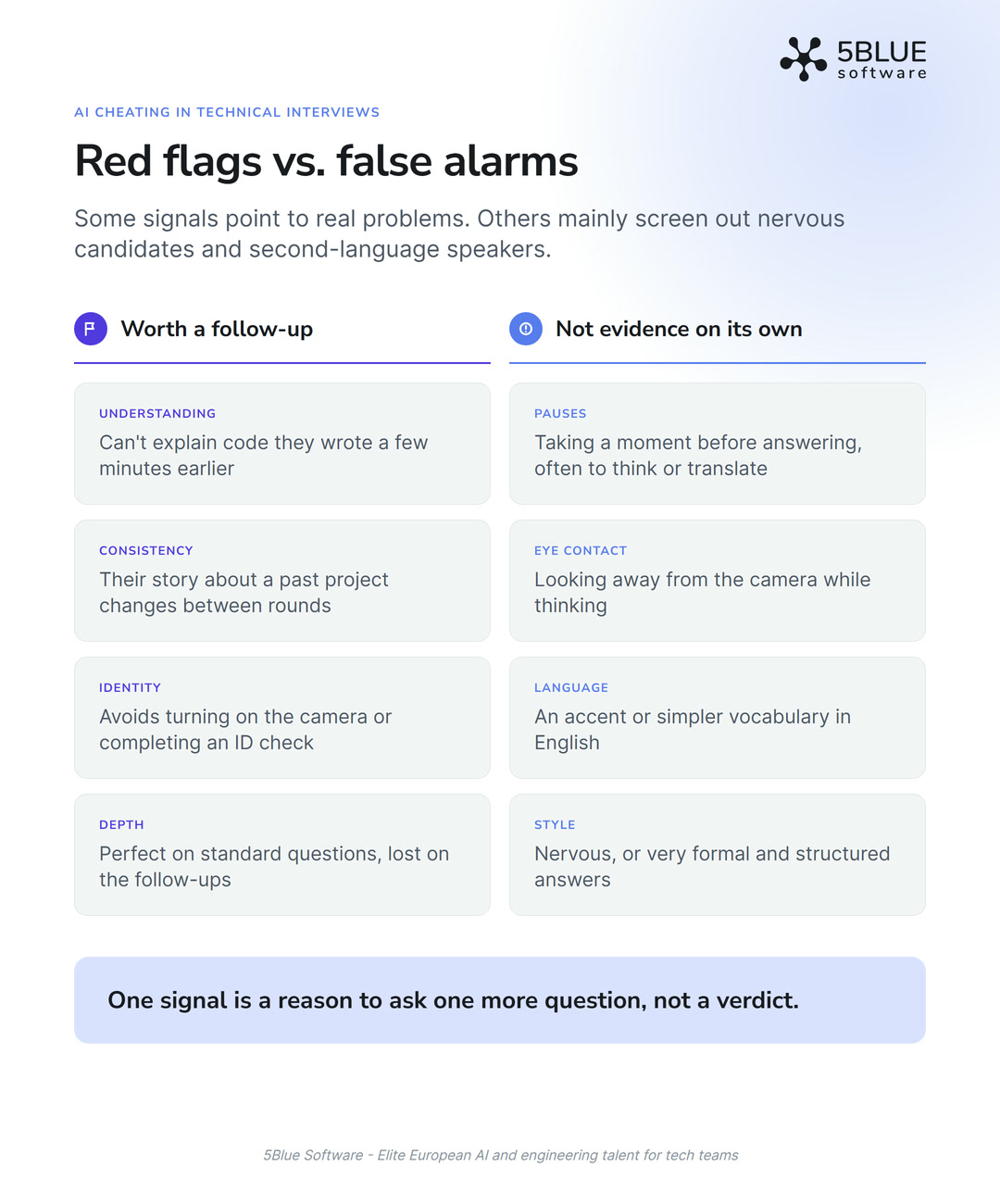
Signals worth a follow-up:
Not evidence on their own:
This matters for remote hiring in particular. Many of the strongest engineers in the global talent pool work in their second or third language. If your filters treat a translation pause as a cheating signal, you will reject the engineers you set out to find.
Treat any single behavior as a reason to ask one more question, not as a verdict. The same applies to automated detection tools: their flags are context for a human, not a decision. If you use monitoring software, tell candidates in advance and check local privacy rules such as GDPR before adding biometric or gaze-tracking tools.
Takeaway: judge understanding, not mannerisms.
Building all five stages in-house takes time, and many teams hire remote engineers too rarely to get good at it. An alternative is staff augmentation through a partner that runs its own engineering hub, where much of the verification has already been done.
When you evaluate a partner, look for:
This is the model behind 5Blue Software's engineering hub in Europe. Our engineers are vetted before you meet them, and you keep full control over the final hiring decision and the team's day-to-day work.
AI has not made remote hiring impossible. It has made weak processes visible. To vet remote developers well in 2026, treat skill misrepresentation and identity fraud as separate problems, set a clear AI policy, and spread your evidence across several formats, from an identity check to the first 30 days on the job. Above all, judge understanding rather than mannerisms, so that you do not filter out the strong engineers you are trying to hire.
If you are evaluating ways to add senior engineers without rebuilding your interview process from scratch, talk to 5Blue about pre-vetted engineers from our engineering hub in Europe.
It depends on your stated policy. Using AI against an explicit ban is a policy breach. Using it where the rules allow it, or where no rules were given, is not. Put your AI policy in writing in every interview invitation so candidates know where the line is.
No single behavior proves it. The most reliable method is to ask follow-up questions. Ask the candidate to explain a line they just wrote, justify a trade-off or adapt the solution to a new requirement. People who understand their answer can go deeper, while answers supplied by AI tend to stay on the surface.
A full return to in-person interviews limits your talent pool. A practical compromise is to run screening remotely and add one verified step for finalists, such as an in-person meeting, a partner-hosted session or a structured paid trial.
Combine a document check through an ID verification service with a live video call, direct contact with former employers through official channels, and a short repeat check at the offer stage and on day one. Working with a partner that employs engineers through a local entity covers most of these checks for you.
The first four stages of the process above usually take five to six hours of the candidate's time and can fit into one or two weeks. The fifth stage runs during the first 30 days of the engagement.

If you are working out how to vet remote developers in 2026, most of the old signals no longer mean much. A take-home test can go into an AI assistant and come back as clean, commented code in twenty minutes. Live coding rounds are not much safer, because overlay tools can read the question from the screen and suggest an answer in real time.
Hiring managers have noticed. In Checkr's 2025 survey of 3,000 US hiring managers, 59% said they had suspected a candidate of using AI to misrepresent themselves. Only 19% were extremely confident that their process would catch a fraudulent applicant.
This guide covers the two separate problems you are solving, the policy decision to make before anything else, a five-stage vetting process, and the signals that matter compared with the ones that unfairly screen out good engineers.
Most advice on AI cheating in technical interviews treats it as a single issue. In practice you are dealing with two, and each needs a different defense.
This candidate is a real person using their real identity. They use AI during the interview to cover gaps in their knowledge. The risk is a hire who performs well in a 60-minute round and then struggles on a real codebase. The defense is interview design: ask for work that AI cannot do on the candidate's behalf, such as explaining decisions, defending trade-offs and adapting when requirements change.
In this case the person on the call is not the person you will employ, or that person does not exist. Gartner predicts that by 2028, one in four candidate profiles worldwide will be fake. In the same Checkr survey, 31% of hiring managers said they had interviewed someone who was later revealed to be using a false identity. In January 2025, the FBI warned that fake remote IT workers had escalated from collecting salaries to stealing source code and extorting employers.
The defense here is verification, and interview questions will not provide it.
Takeaway: a better coding question will not stop a stand-in, and an ID check will not reveal someone who cannot code without an assistant. Your process needs both.
Before you change a single interview question, decide what you are actually testing for. Companies tend to choose one of three policies:
Our recommendation is to match the policy to the job. If your engineers use Copilot, Cursor or Claude every day, banning AI in the interview measures a job that does not exist.
Whichever policy you choose, write it into the interview invitation. A clear rule turns "cheating" into a policy breach you can act on. It also means honest candidates are not disadvantaged against those who break a rule nobody stated.
Takeaway: an AI-assisted coding interview is fair only when every candidate knows the rules in advance.
The process below addresses both problems. Each stage checks something the others cannot, so a candidate would have to fake all five consistently to get through.
Start with a live video call with the camera on, and match a government ID through a verification service. Check that the candidate's work history is consistent across their résumé, LinkedIn and GitHub. Following FBI guidance, contact former employers through the company's official channels rather than numbers the candidate provides. Repeat a light check at the offer stage and on day one, so you know the person who starts is the person you interviewed.
Spend 30 minutes on one project from the candidate's résumé. Ask why they chose that database, what broke in production and what they would change now. Follow each answer at least three levels deep. AI can produce a plausible first answer, but it struggles to keep a consistent story through the fourth "why" about a system only the candidate has worked on.
Give the candidate about 80 lines of AI-generated code containing two subtle bugs and one design problem. Ask what they would ship, what they would fix and what they would question. This reflects the job as it is now: engineers spend more and more of their time reviewing code they did not write.
Run a live session on a messy, realistic repository and change one requirement halfway through. Watch how the candidate breaks down the problem, what questions they ask and how they handle the change. If your policy allows AI, let them use it and assess how carefully they check its output.
Vetting does not end at the offer. Agree on concrete outcomes for the first 30 days, then check that commits, pull request discussions and camera-on stand-ups match the level you saw in interviews. If someone else did the interviews, the gap usually shows within a couple of weeks.
Takeaway: a strong remote developer vetting process spreads evidence across several formats and continues for the first month on the job.
Many detection guides tell interviewers to watch for pauses, eye movements and unusually polished answers. Some of these signals are useful. Others mostly penalize nervous candidates, neurodivergent people and engineers who speak English as a second language.
Signals worth a follow-up:
Not evidence on their own:
This matters for remote hiring in particular. Many of the strongest engineers in the global talent pool work in their second or third language. If your filters treat a translation pause as a cheating signal, you will reject the engineers you set out to find.
Treat any single behavior as a reason to ask one more question, not as a verdict. The same applies to automated detection tools: their flags are context for a human, not a decision. If you use monitoring software, tell candidates in advance and check local privacy rules such as GDPR before adding biometric or gaze-tracking tools.
Takeaway: judge understanding, not mannerisms.
Building all five stages in-house takes time, and many teams hire remote engineers too rarely to get good at it. An alternative is staff augmentation through a partner that runs its own engineering hub, where much of the verification has already been done.
When you evaluate a partner, look for:
This is the model behind 5Blue Software's engineering hub in Europe. Our engineers are vetted before you meet them, and you keep full control over the final hiring decision and the team's day-to-day work.
AI has not made remote hiring impossible. It has made weak processes visible. To vet remote developers well in 2026, treat skill misrepresentation and identity fraud as separate problems, set a clear AI policy, and spread your evidence across several formats, from an identity check to the first 30 days on the job. Above all, judge understanding rather than mannerisms, so that you do not filter out the strong engineers you are trying to hire.
If you are evaluating ways to add senior engineers without rebuilding your interview process from scratch, talk to 5Blue about pre-vetted engineers from our engineering hub in Europe.
It depends on your stated policy. Using AI against an explicit ban is a policy breach. Using it where the rules allow it, or where no rules were given, is not. Put your AI policy in writing in every interview invitation so candidates know where the line is.
No single behavior proves it. The most reliable method is to ask follow-up questions. Ask the candidate to explain a line they just wrote, justify a trade-off or adapt the solution to a new requirement. People who understand their answer can go deeper, while answers supplied by AI tend to stay on the surface.
A full return to in-person interviews limits your talent pool. A practical compromise is to run screening remotely and add one verified step for finalists, such as an in-person meeting, a partner-hosted session or a structured paid trial.
Combine a document check through an ID verification service with a live video call, direct contact with former employers through official channels, and a short repeat check at the offer stage and on day one. Working with a partner that employs engineers through a local entity covers most of these checks for you.
The first four stages of the process above usually take five to six hours of the candidate's time and can fit into one or two weeks. The fifth stage runs during the first 30 days of the engagement.
.svg)


.svg)