
.jpg)
The job title "AI engineer" has become a catch-all, and that's the root of the problem. Companies post it expecting one person to design the model architecture, clean the training data, build the deployment pipeline, monitor performance in production, and translate business requirements into technical specs. In practice, those are four or five distinct skill sets.
A senior AI engineer who's excellent at model architecture and fine-tuning is often mediocre at production-grade data engineering, and vice versa. Asking one person to do both means one side of the work suffers, usually the unglamorous side: data pipelines, monitoring, evaluation. That's exactly the work that determines whether an AI product is reliable enough to ship.
There's also a sequencing problem. Teams hire an AI engineer first because that's the visible, "sexy" role. But without clean, well-structured data, there's nothing good for that engineer to build against. The result is a highly paid specialist spending half their time doing data cleanup instead of the work you hired them for.
The fix isn't complicated: define the roles by the work that needs to happen, then hire against a sequence, not a single job description.
Here's the full breakdown, in the order most teams should hire them.
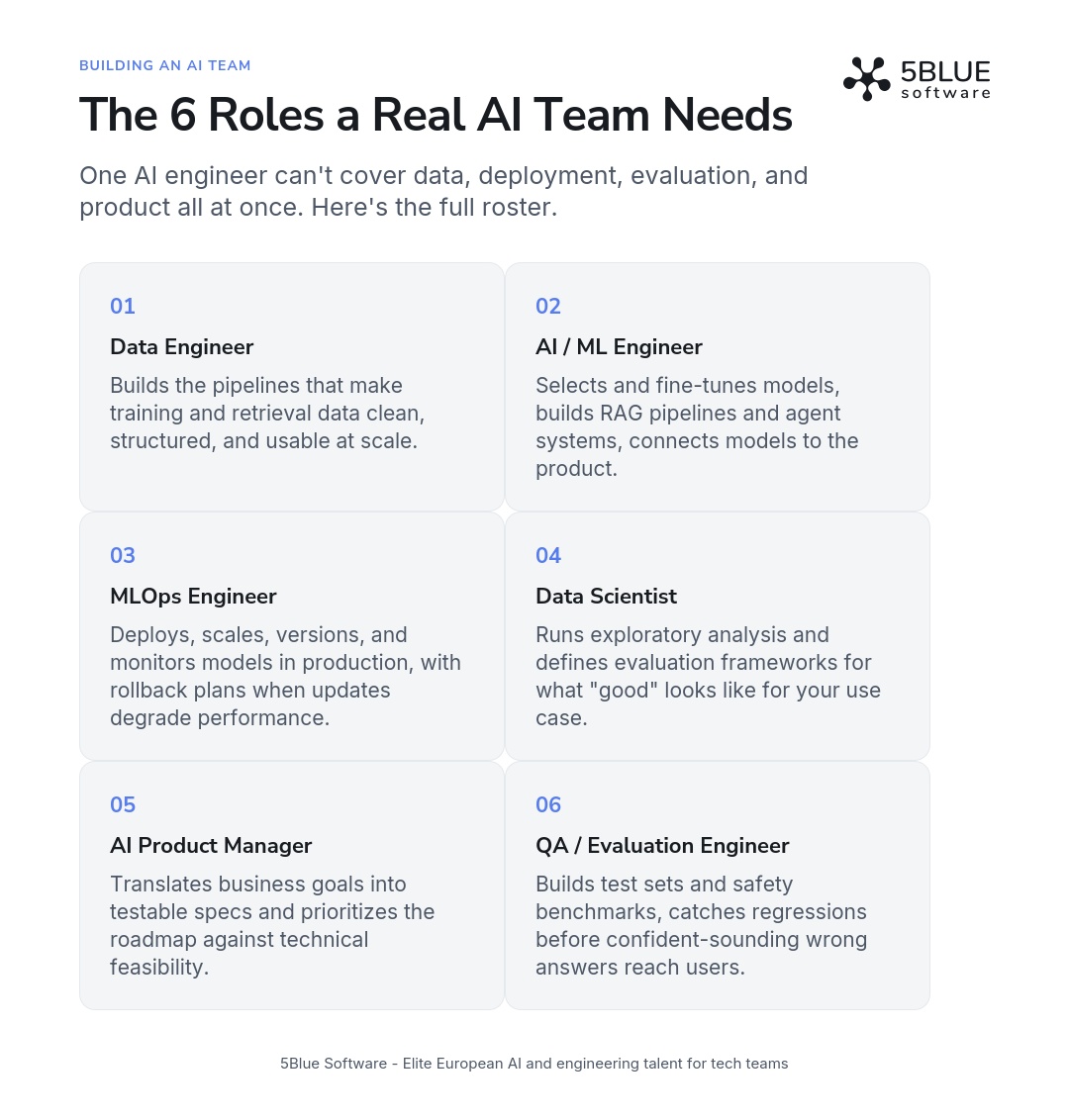
1. Data Engineer
Before any model gets built, someone needs to make sure the data feeding it is accessible, structured, and reliable. Data engineers build the pipelines that pull data from your systems, clean it, and make it usable at scale. If your training or retrieval data is a mess, this is your first hire, not your third.
What they own: ETL/ELT pipelines, data warehousing, data quality checks, and making sure the AI engineer has something solid to build on.
2. AI/ML Engineer
This is the role most people picture when they think "AI hire." They design and train models, fine-tune existing foundation models for your use case, and build the systems that connect a model to your application logic (RAG pipelines, agent frameworks, embedding systems).
What they own: model selection and fine-tuning, prompt and context engineering at the systems level, integration between the model and your product.
3. MLOps Engineer
A model that works in a Jupyter notebook is not a model that works in production. MLOps engineers build the infrastructure to deploy, version, scale, and monitor models reliably, including rollback plans when a model update degrades performance. This role is where most early-stage AI products quietly fail: they never get past "it works on my machine."
What they own: CI/CD for models, infrastructure and scaling, deployment monitoring, versioning and rollback processes.
4. Data Scientist
Data scientists focus on the analytical layer: what patterns exist in your data, which approach is likely to work, and how to measure whether the model is actually solving the business problem. In smaller teams this overlaps with the AI engineer role, but as the product matures, the analytical and engineering skill sets diverge enough to warrant separate hires.
What they own: exploratory analysis, model evaluation frameworks, defining what "good" looks like for your specific use case.
5. AI Product Manager
Someone has to translate "the model should be more helpful" into a concrete, testable specification, and prioritize the roadmap between what's technically feasible and what actually moves the business. Without this role, engineering teams tend to either over-build (chasing model perfection nobody asked for) or under-build (shipping something the model can't actually support well).
What they own: requirements definition, roadmap prioritization, coordination between engineering, design, and stakeholders.
6. QA / Evaluation Engineer
AI systems fail differently than traditional software. They don't throw clean error messages; they produce confident, plausible-sounding wrong answers. A dedicated evaluation engineer builds test sets, defines accuracy and safety benchmarks, and catches regressions before they reach users. Skipping this role is one of the most common and most expensive mistakes early AI teams make.
What they own: eval frameworks, regression testing, bias and safety checks, human-in-the-loop review processes.
Most teams don't need all six roles on day one. A practical build-out looks like this:
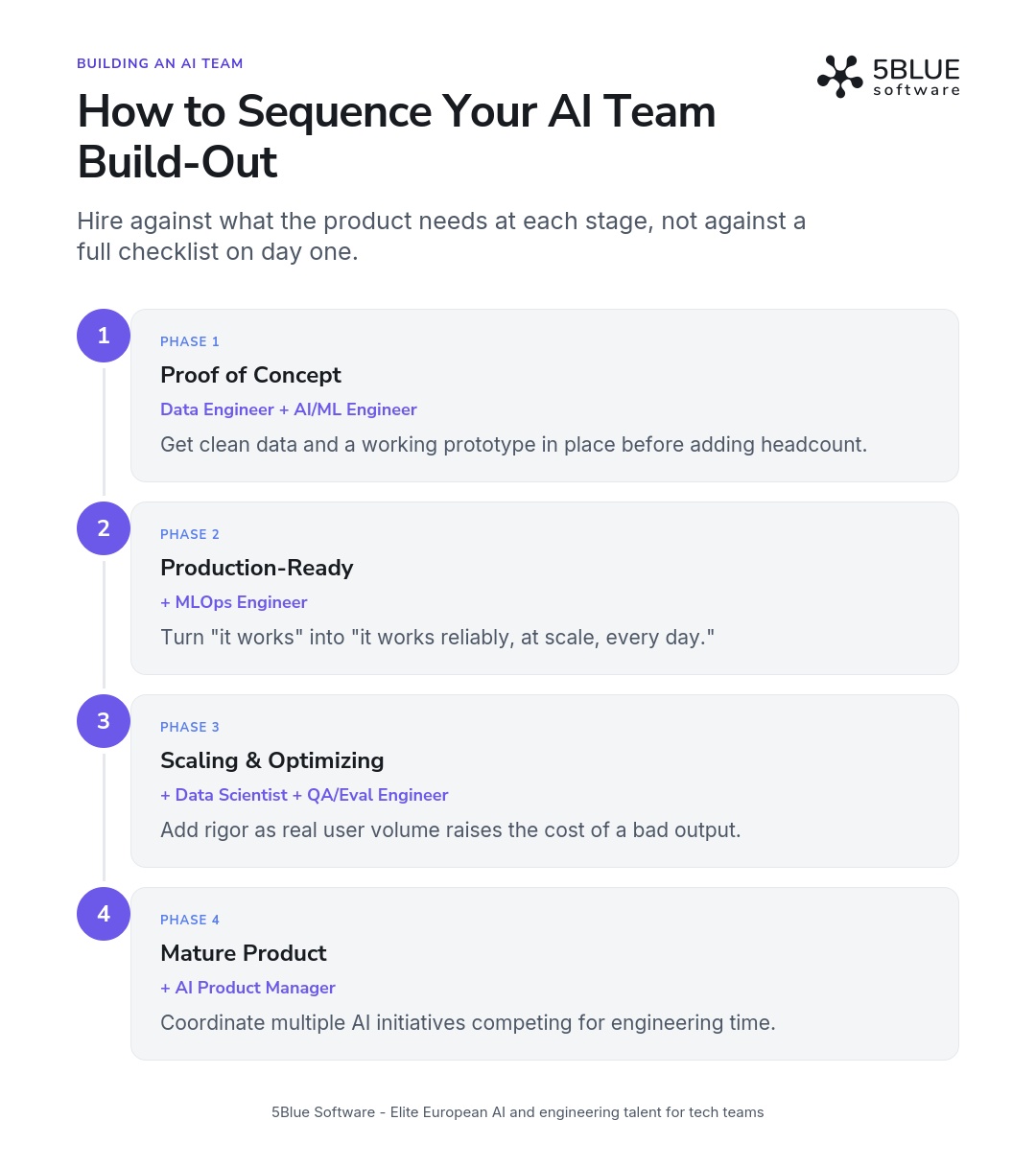
Skipping straight to a five-person team before you've validated the use case is how AI budgets get burned without shipping anything. Sequence the hires against what the product actually needs at each stage, not against a checklist.
A useful gut check at each phase: if you can't clearly name the failure mode the next hire prevents, you're probably hiring too early. A data engineer prevents "the model has nothing good to learn from." An MLOps engineer prevents "the model worked in the demo and broke in production." A QA/evaluation engineer prevents "we found out the model was wrong from a customer complaint instead of a dashboard." If you can't articulate the failure mode, hold off and revisit once the product is further along.
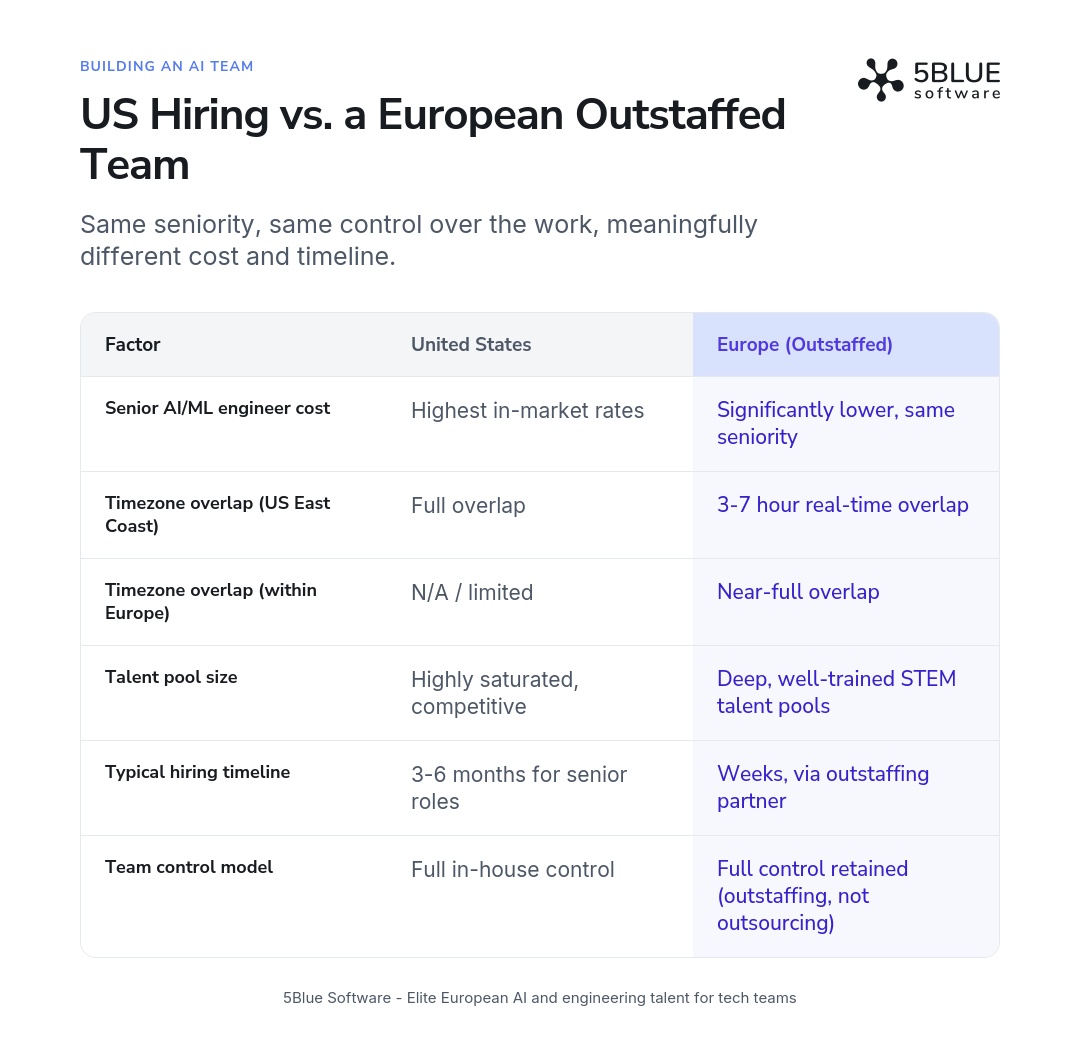
Every one of these roles is in short supply globally, and US salaries for senior AI/ML talent have climbed accordingly. This is exactly where a nearshore hiring strategy pays off, and Europe has become one of the strongest markets for it.
Europe combines several of the continent's deepest engineering talent pools with a STEM education tradition that has been producing strong computer science and engineering graduates for decades. European developers consistently place well in international coding competitions, and the region's engineering culture tends to be technical and rigorous, which matters for roles like MLOps and evaluation engineering where precision is the job.
The practical advantages for a US or UK company building an AI team:
For roles like data engineering and MLOps, where the work is deep and technical but not necessarily tied to your specific business context, building through a European outstaffing model is one of the fastest ways to get senior talent in place without a six-month US hiring cycle.
Hiring the AI engineer first, before the data foundation exists. You end up paying a specialist to do cleanup work that a data engineer could handle faster and cheaper.
Treating MLOps as optional. Teams that skip this role usually find out why it matters the hard way, when a model update breaks production and there's no rollback plan.
No one owns evaluation. Without a QA/evaluation function, teams find out their model is underperforming from angry customers instead of from a dashboard.
Building the whole team before validating the use case. A lean Phase 1 team (data engineer + AI engineer) can validate whether the AI initiative is worth scaling before you commit to five or six salaries.
Assuming every role needs to be full-time and in-house from day one. Especially for MLOps and data engineering, a nearshore or outstaffed hire can fill the gap at a fraction of the cost and timeline of a full-time local search, while you validate whether the role needs to be permanent.
Underestimating how long senior AI hiring takes domestically. Senior AI/ML and MLOps talent is scarce enough in the US and Western Europe that a local search can easily run three to six months before an offer is signed. If your roadmap depends on shipping this quarter, that timeline alone is often the deciding factor in looking at a nearshore or outstaffed hiring model instead.
Do I need all six roles to launch an AI product? No. Most teams start with a data engineer and an AI/ML engineer to build and validate a prototype, then add MLOps, data science, and evaluation roles as the product moves toward production and scale.
What's the difference between an AI engineer and a data scientist? An AI engineer builds and integrates models into working systems. A data scientist focuses on analysis, evaluation frameworks, and determining whether the model is actually solving the problem. In small teams, one person often does both.
Is MLOps really necessary for a small AI team? Yes, once you're serving real users. MLOps is what turns "the model works" into "the model works reliably, every day, at scale." Skipping it is one of the most common reasons AI products stall after a promising prototype.
Why consider European talent specifically for these roles? Europe combines deep, well-trained engineering talent pools with strong timezone overlap for US and UK teams and meaningfully lower costs than domestic hiring, without a quality tradeoff. It's particularly effective for technical roles like MLOps and data engineering, where the work is deep but not tightly coupled to internal business context.
How long does it typically take to build out a full AI team? With a phased approach, a lean two-person team can be in place within a few weeks. A full six-role team, built out in phases as the product scales, typically takes several months if hiring locally, but can be significantly compressed with an outstaffing partner handling sourcing and vetting in parallel.
If you're mapping out an AI team and trying to figure out which roles to hire first, or which ones make sense to build through an outstaffing partner rather than a lengthy local search, it's worth talking through your specific roadmap before you commit to headcount. Get in touch to see how a European engineering team could fill the gaps in yours.

The job title "AI engineer" has become a catch-all, and that's the root of the problem. Companies post it expecting one person to design the model architecture, clean the training data, build the deployment pipeline, monitor performance in production, and translate business requirements into technical specs. In practice, those are four or five distinct skill sets.
A senior AI engineer who's excellent at model architecture and fine-tuning is often mediocre at production-grade data engineering, and vice versa. Asking one person to do both means one side of the work suffers, usually the unglamorous side: data pipelines, monitoring, evaluation. That's exactly the work that determines whether an AI product is reliable enough to ship.
There's also a sequencing problem. Teams hire an AI engineer first because that's the visible, "sexy" role. But without clean, well-structured data, there's nothing good for that engineer to build against. The result is a highly paid specialist spending half their time doing data cleanup instead of the work you hired them for.
The fix isn't complicated: define the roles by the work that needs to happen, then hire against a sequence, not a single job description.
Here's the full breakdown, in the order most teams should hire them.
1. Data Engineer
Before any model gets built, someone needs to make sure the data feeding it is accessible, structured, and reliable. Data engineers build the pipelines that pull data from your systems, clean it, and make it usable at scale. If your training or retrieval data is a mess, this is your first hire, not your third.
What they own: ETL/ELT pipelines, data warehousing, data quality checks, and making sure the AI engineer has something solid to build on.
2. AI/ML Engineer
This is the role most people picture when they think "AI hire." They design and train models, fine-tune existing foundation models for your use case, and build the systems that connect a model to your application logic (RAG pipelines, agent frameworks, embedding systems).
What they own: model selection and fine-tuning, prompt and context engineering at the systems level, integration between the model and your product.
3. MLOps Engineer
A model that works in a Jupyter notebook is not a model that works in production. MLOps engineers build the infrastructure to deploy, version, scale, and monitor models reliably, including rollback plans when a model update degrades performance. This role is where most early-stage AI products quietly fail: they never get past "it works on my machine."
What they own: CI/CD for models, infrastructure and scaling, deployment monitoring, versioning and rollback processes.
4. Data Scientist
Data scientists focus on the analytical layer: what patterns exist in your data, which approach is likely to work, and how to measure whether the model is actually solving the business problem. In smaller teams this overlaps with the AI engineer role, but as the product matures, the analytical and engineering skill sets diverge enough to warrant separate hires.
What they own: exploratory analysis, model evaluation frameworks, defining what "good" looks like for your specific use case.
5. AI Product Manager
Someone has to translate "the model should be more helpful" into a concrete, testable specification, and prioritize the roadmap between what's technically feasible and what actually moves the business. Without this role, engineering teams tend to either over-build (chasing model perfection nobody asked for) or under-build (shipping something the model can't actually support well).
What they own: requirements definition, roadmap prioritization, coordination between engineering, design, and stakeholders.
6. QA / Evaluation Engineer
AI systems fail differently than traditional software. They don't throw clean error messages; they produce confident, plausible-sounding wrong answers. A dedicated evaluation engineer builds test sets, defines accuracy and safety benchmarks, and catches regressions before they reach users. Skipping this role is one of the most common and most expensive mistakes early AI teams make.
What they own: eval frameworks, regression testing, bias and safety checks, human-in-the-loop review processes.
Most teams don't need all six roles on day one. A practical build-out looks like this:
Skipping straight to a five-person team before you've validated the use case is how AI budgets get burned without shipping anything. Sequence the hires against what the product actually needs at each stage, not against a checklist.
A useful gut check at each phase: if you can't clearly name the failure mode the next hire prevents, you're probably hiring too early. A data engineer prevents "the model has nothing good to learn from." An MLOps engineer prevents "the model worked in the demo and broke in production." A QA/evaluation engineer prevents "we found out the model was wrong from a customer complaint instead of a dashboard." If you can't articulate the failure mode, hold off and revisit once the product is further along.
Every one of these roles is in short supply globally, and US salaries for senior AI/ML talent have climbed accordingly. This is exactly where a nearshore hiring strategy pays off, and Europe has become one of the strongest markets for it.
Europe combines several of the continent's deepest engineering talent pools with a STEM education tradition that has been producing strong computer science and engineering graduates for decades. European developers consistently place well in international coding competitions, and the region's engineering culture tends to be technical and rigorous, which matters for roles like MLOps and evaluation engineering where precision is the job.
The practical advantages for a US or UK company building an AI team:
For roles like data engineering and MLOps, where the work is deep and technical but not necessarily tied to your specific business context, building through a European outstaffing model is one of the fastest ways to get senior talent in place without a six-month US hiring cycle.
Hiring the AI engineer first, before the data foundation exists. You end up paying a specialist to do cleanup work that a data engineer could handle faster and cheaper.
Treating MLOps as optional. Teams that skip this role usually find out why it matters the hard way, when a model update breaks production and there's no rollback plan.
No one owns evaluation. Without a QA/evaluation function, teams find out their model is underperforming from angry customers instead of from a dashboard.
Building the whole team before validating the use case. A lean Phase 1 team (data engineer + AI engineer) can validate whether the AI initiative is worth scaling before you commit to five or six salaries.
Assuming every role needs to be full-time and in-house from day one. Especially for MLOps and data engineering, a nearshore or outstaffed hire can fill the gap at a fraction of the cost and timeline of a full-time local search, while you validate whether the role needs to be permanent.
Underestimating how long senior AI hiring takes domestically. Senior AI/ML and MLOps talent is scarce enough in the US and Western Europe that a local search can easily run three to six months before an offer is signed. If your roadmap depends on shipping this quarter, that timeline alone is often the deciding factor in looking at a nearshore or outstaffed hiring model instead.
Do I need all six roles to launch an AI product? No. Most teams start with a data engineer and an AI/ML engineer to build and validate a prototype, then add MLOps, data science, and evaluation roles as the product moves toward production and scale.
What's the difference between an AI engineer and a data scientist? An AI engineer builds and integrates models into working systems. A data scientist focuses on analysis, evaluation frameworks, and determining whether the model is actually solving the problem. In small teams, one person often does both.
Is MLOps really necessary for a small AI team? Yes, once you're serving real users. MLOps is what turns "the model works" into "the model works reliably, every day, at scale." Skipping it is one of the most common reasons AI products stall after a promising prototype.
Why consider European talent specifically for these roles? Europe combines deep, well-trained engineering talent pools with strong timezone overlap for US and UK teams and meaningfully lower costs than domestic hiring, without a quality tradeoff. It's particularly effective for technical roles like MLOps and data engineering, where the work is deep but not tightly coupled to internal business context.
How long does it typically take to build out a full AI team? With a phased approach, a lean two-person team can be in place within a few weeks. A full six-role team, built out in phases as the product scales, typically takes several months if hiring locally, but can be significantly compressed with an outstaffing partner handling sourcing and vetting in parallel.
If you're mapping out an AI team and trying to figure out which roles to hire first, or which ones make sense to build through an outstaffing partner rather than a lengthy local search, it's worth talking through your specific roadmap before you commit to headcount. Get in touch to see how a European engineering team could fill the gaps in yours.
.svg)


.svg)