
.jpg)
Every engineering leader hits this decision eventually. You have a roadmap, a deadline, and a headcount plan that doesn't match either one. Do you post the job, run a six-month hiring process, and build in-house? Or do you bring in an outstaffed team that can start in weeks?
There's no universal right answer. But there is a wrong way to make the call: defaulting to "we've always hired in-house" or "outstaffing is just cheaper" without actually running the numbers. This piece breaks down the real tradeoffs, so you can match the decision to what your team actually needs right now, not what feels most familiar.
The build vs. buy framework comes from procurement, where companies decide whether to build software internally or buy it off the shelf. Applied to hiring, it works the same way:
Build means hiring in-house. You recruit, onboard, and manage engineers as full-time employees, embedded directly in your org chart.
Buy means bringing in an outstaffed team: engineers who work exclusively on your product, under your technical direction, but are employed and managed administratively by an outstaffing partner. This is different from outsourcing, where a vendor owns the deliverable. With outstaffing, you keep full control of the roadmap, the code, and the day-to-day work. The partner handles recruiting, payroll, compliance, and retention logistics.
Most companies aren't choosing one model forever. They're choosing the right model for a given project, team, or growth phase.
.jpg)
Cost is usually the first thing on the table, and it's more nuanced than "outstaffing is cheaper."
A fully loaded in-house senior engineer in the US typically costs $180,000-$220,000 a year once you factor in salary, benefits, payroll tax, equipment, and office overhead. In Western Europe, that number runs $110,000-$150,000 depending on the market. Add recruiting costs: agency fees or internal recruiter time can add another 15-25% of first-year salary before the person writes a line of code.
An outstaffed senior engineer, sourced from a market like Ukraine, typically runs $45,000-$75,000 a year all-in, with no recruiting fee layered on top and no long-term severance exposure if the engagement ends.
But cost per head isn't the full picture. Two things change the math:
Ramp time. An in-house hire needs 60-90 days to source, interview, and onboard before they're productive. An outstaffed engineer from an established partner can typically start within 2-4 weeks, because the partner maintains a bench of vetted talent.
Utilization risk. If a project ends or pivots, an in-house employee is a fixed cost you carry regardless. An outstaffed engineer can be rolled off a contract with far less financial and legal exposure.
Neither model is "the cheap one" or "the expensive one" in isolation. The real question is which cost structure matches your risk tolerance and hiring timeline.
Building in-house makes the most sense in a few specific situations:
The role is core to your competitive moat. If someone is going to own architecture decisions that define your product for the next five years, you generally want them fully embedded, with equity, long-term incentive alignment, and deep institutional context that builds over years, not months.
You need someone who'll also do things outside engineering. Team leads who run performance reviews, sit in on hiring committees, or represent engineering to the board are harder to slot in externally.
You're building a permanent, stable team of a predictable size. If you know you'll need this exact skill set for the next five-plus years and you have the runway to hire deliberately, in-house hiring lets you build culture and depth that pays off over time.
You operate in a regulated environment with strict data residency or clearance requirements. Some contracts, especially in defense, healthcare, or government, legally require employees rather than contracted talent.
Outstaffing tends to win in a different set of situations:
You need to move faster than your hiring pipeline allows. If a roadmap commitment is at risk because you can't fill three backend roles in time, an outstaffed team can plug the gap in weeks instead of months.
The work is well-scoped and doesn't require deep institutional history. Feature development, platform migrations, QA automation, and infrastructure work often fit well here, because the team can ramp on documented requirements without needing years of tribal knowledge.
You're testing a new market, product line, or technical direction. If you're not sure the initiative will scale into a permanent team, outstaffing lets you validate the idea without committing to permanent headcount you might need to unwind later.
You want senior talent without the senior-market price tag. Markets like Ukraine have a deep, mature engineering talent pool: strong STEM programs out of institutions like KPI and Lviv Polytechnic have produced tens of thousands of computer science graduates over the past two decades, and Ukrainian developers consistently place well in competitive programming benchmarks like TopCoder and HackerRank. The talent quality is comparable to Western Europe; the cost structure isn't.
Every engineering leader considering outstaffing runs into the same three concerns. They're worth taking seriously rather than waving away.
Timezone. Ukraine sits in EET/EEST (UTC+2/UTC+3), which gives a strong working overlap with Western Europe and a workable 3-7 hour overlap window with US East Coast teams. For most agile workflows, that's enough for daily standups and real-time collaboration, though fully synchronous pairing across a 9-hour gap does require some schedule flexibility on both sides.
Communication quality. This is a legitimate risk with an unvetted partner, and a non-issue with a mature one. Ask any outstaffing partner directly about English proficiency standards, how they run technical interviews, and whether they can put you in touch with a current client for a reference call before you sign anything.
Control and IP protection. This is the most common misconception about outstaffing. In a proper outstaffing arrangement, you retain full control over the technical roadmap, code repositories, and daily task assignment. The contract should explicitly assign IP to your company, not the staffing partner. If a partner is vague about this in the contract, that's a red flag, not a detail to sort out later.
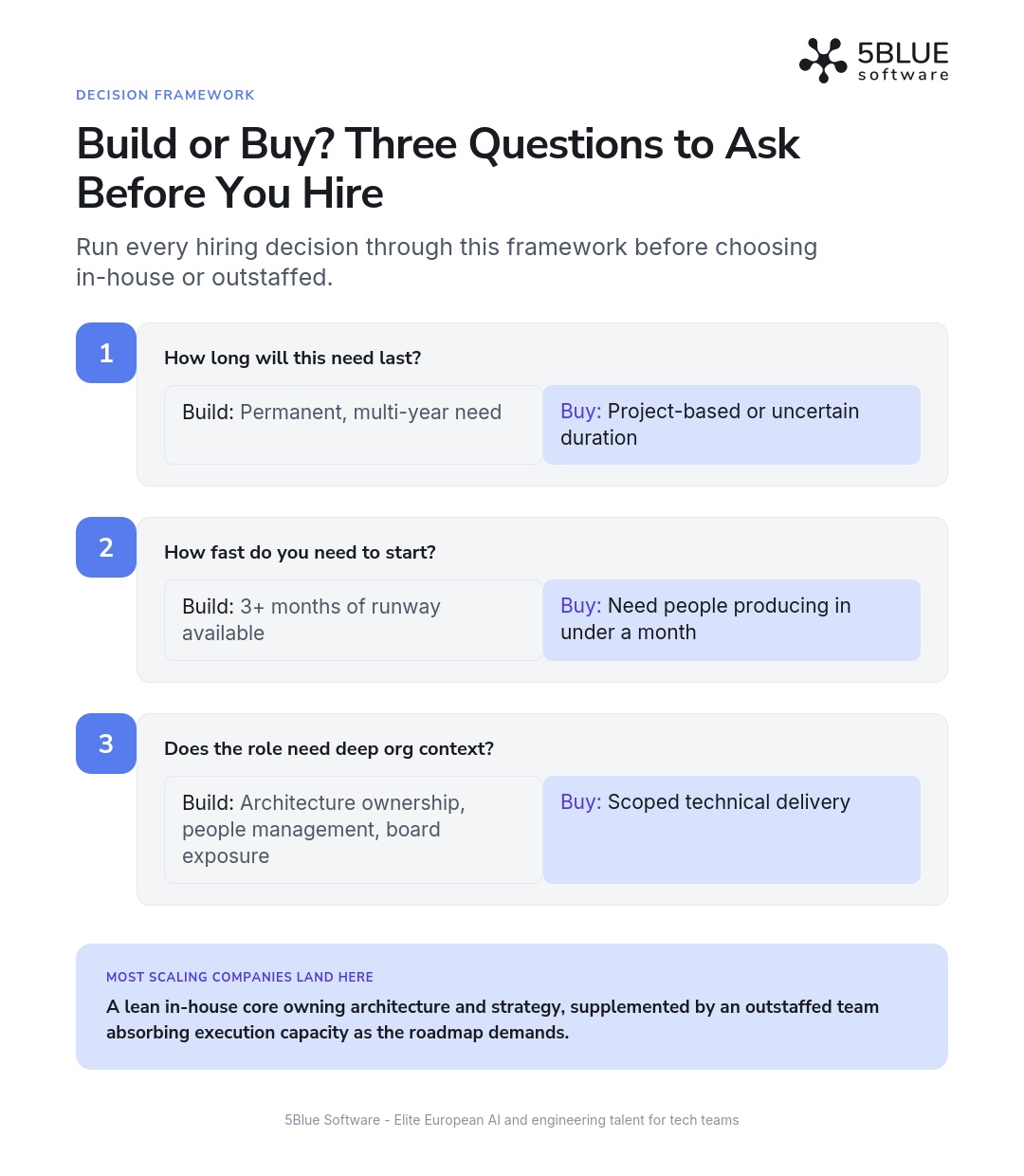
Rather than treating this as an all-or-nothing choice, run it project by project or team by team using three questions:
1. How long is this need going to last?Permanent, multi-year need → lean in-house. Project-based or uncertain duration → lean outstaffed.
2. How fast do you need to start?If you have 3+ months of runway before you need people producing → in-house is viable. If you need people producing in under a month → outstaffing is often the only realistic path.
3. Does the role require deep, non-technical organizational context?Roles that blend technical work with people management, board exposure, or long-term architectural ownership → in-house. Roles focused on scoped technical delivery → outstaffed.
Most scaling companies land on a hybrid model: a smaller in-house core that owns architecture, product direction, and long-term technical strategy, supplemented by an outstaffed team that absorbs execution capacity as the roadmap demands. This isn't a compromise position, it's usually the most efficient one, because it lets you spend your fixed headcount on the roles where continuity matters most, and stay flexible everywhere else.
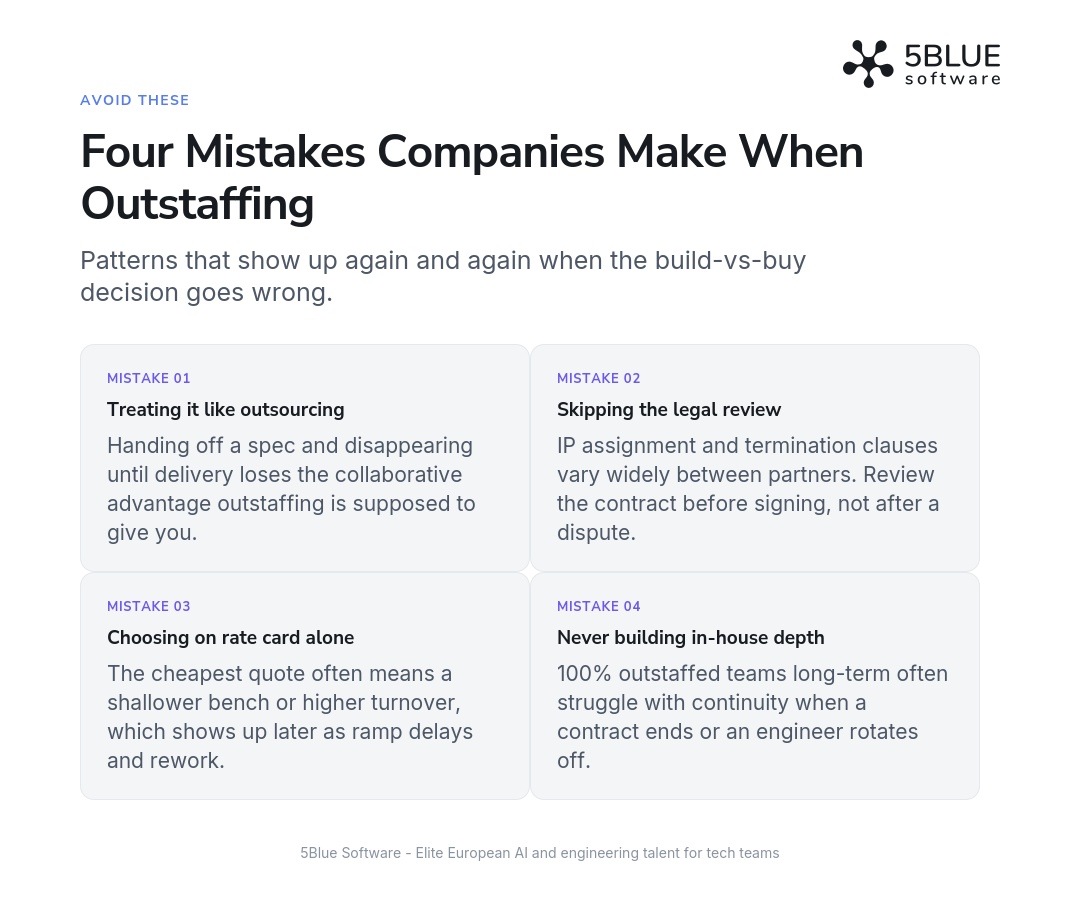
A few patterns show up repeatedly when companies get this decision wrong:
Is outstaffing the same as outsourcing?No. With outsourcing, a vendor owns the deliverable and manages the work independently. With outstaffing, you manage the team's day-to-day work and technical direction directly; the partner handles employment, payroll, and compliance.
How quickly can an outstaffed team start?With an established partner that maintains a vetted talent bench, most engagements start within 2-4 weeks, compared to 60-90 days for a typical in-house hire.
Is Ukrainian outstaffing still viable given the current situation?Yes. Ukraine's IT sector has continued operating throughout, with most development teams working remotely and cloud-based infrastructure. Many outstaffing partners maintain redundancy plans, including backup power and distributed team locations, specifically to keep delivery stable.
Who owns the code and IP in an outstaffing arrangement?Your company should, in full, as long as the contract explicitly assigns IP rights to you. This should be a standard, non-negotiable clause in any outstaffing agreement.
Can you mix in-house and outstaffed talent on the same team?Yes, and it's common. Many engineering orgs run blended teams where in-house leads own architecture and roadmap decisions, and outstaffed engineers handle execution, working in the same sprints and tools as everyone else.
Build vs. buy isn't a philosophy, it's a resourcing decision that should get revisited every time your roadmap or growth stage changes. In-house hiring is worth the time investment when you need deep, permanent ownership of a role. Outstaffing is worth considering when speed, flexibility, or cost efficiency matter more than long-term embeddedness, and when you have a partner you can trust with real technical ownership, not just headcount.
If you're weighing this decision for an upcoming project and want a second opinion on what mix of in-house and outstaffed talent would actually fit your roadmap, that's a conversation worth having before you post a single job listing.
Ready to explore what an outstaffed engineering team could look like for your roadmap? Get in touch and we'll map out the right mix for your team.

Every engineering leader hits this decision eventually. You have a roadmap, a deadline, and a headcount plan that doesn't match either one. Do you post the job, run a six-month hiring process, and build in-house? Or do you bring in an outstaffed team that can start in weeks?
There's no universal right answer. But there is a wrong way to make the call: defaulting to "we've always hired in-house" or "outstaffing is just cheaper" without actually running the numbers. This piece breaks down the real tradeoffs, so you can match the decision to what your team actually needs right now, not what feels most familiar.
The build vs. buy framework comes from procurement, where companies decide whether to build software internally or buy it off the shelf. Applied to hiring, it works the same way:
Build means hiring in-house. You recruit, onboard, and manage engineers as full-time employees, embedded directly in your org chart.
Buy means bringing in an outstaffed team: engineers who work exclusively on your product, under your technical direction, but are employed and managed administratively by an outstaffing partner. This is different from outsourcing, where a vendor owns the deliverable. With outstaffing, you keep full control of the roadmap, the code, and the day-to-day work. The partner handles recruiting, payroll, compliance, and retention logistics.
Most companies aren't choosing one model forever. They're choosing the right model for a given project, team, or growth phase.
Cost is usually the first thing on the table, and it's more nuanced than "outstaffing is cheaper."
A fully loaded in-house senior engineer in the US typically costs $180,000-$220,000 a year once you factor in salary, benefits, payroll tax, equipment, and office overhead. In Western Europe, that number runs $110,000-$150,000 depending on the market. Add recruiting costs: agency fees or internal recruiter time can add another 15-25% of first-year salary before the person writes a line of code.
An outstaffed senior engineer, sourced from a market like Ukraine, typically runs $45,000-$75,000 a year all-in, with no recruiting fee layered on top and no long-term severance exposure if the engagement ends.
But cost per head isn't the full picture. Two things change the math:
Ramp time. An in-house hire needs 60-90 days to source, interview, and onboard before they're productive. An outstaffed engineer from an established partner can typically start within 2-4 weeks, because the partner maintains a bench of vetted talent.
Utilization risk. If a project ends or pivots, an in-house employee is a fixed cost you carry regardless. An outstaffed engineer can be rolled off a contract with far less financial and legal exposure.
Neither model is "the cheap one" or "the expensive one" in isolation. The real question is which cost structure matches your risk tolerance and hiring timeline.
Building in-house makes the most sense in a few specific situations:
The role is core to your competitive moat. If someone is going to own architecture decisions that define your product for the next five years, you generally want them fully embedded, with equity, long-term incentive alignment, and deep institutional context that builds over years, not months.
You need someone who'll also do things outside engineering. Team leads who run performance reviews, sit in on hiring committees, or represent engineering to the board are harder to slot in externally.
You're building a permanent, stable team of a predictable size. If you know you'll need this exact skill set for the next five-plus years and you have the runway to hire deliberately, in-house hiring lets you build culture and depth that pays off over time.
You operate in a regulated environment with strict data residency or clearance requirements. Some contracts, especially in defense, healthcare, or government, legally require employees rather than contracted talent.
Outstaffing tends to win in a different set of situations:
You need to move faster than your hiring pipeline allows. If a roadmap commitment is at risk because you can't fill three backend roles in time, an outstaffed team can plug the gap in weeks instead of months.
The work is well-scoped and doesn't require deep institutional history. Feature development, platform migrations, QA automation, and infrastructure work often fit well here, because the team can ramp on documented requirements without needing years of tribal knowledge.
You're testing a new market, product line, or technical direction. If you're not sure the initiative will scale into a permanent team, outstaffing lets you validate the idea without committing to permanent headcount you might need to unwind later.
You want senior talent without the senior-market price tag. Markets like Ukraine have a deep, mature engineering talent pool: strong STEM programs out of institutions like KPI and Lviv Polytechnic have produced tens of thousands of computer science graduates over the past two decades, and Ukrainian developers consistently place well in competitive programming benchmarks like TopCoder and HackerRank. The talent quality is comparable to Western Europe; the cost structure isn't.
Every engineering leader considering outstaffing runs into the same three concerns. They're worth taking seriously rather than waving away.
Timezone. Ukraine sits in EET/EEST (UTC+2/UTC+3), which gives a strong working overlap with Western Europe and a workable 3-7 hour overlap window with US East Coast teams. For most agile workflows, that's enough for daily standups and real-time collaboration, though fully synchronous pairing across a 9-hour gap does require some schedule flexibility on both sides.
Communication quality. This is a legitimate risk with an unvetted partner, and a non-issue with a mature one. Ask any outstaffing partner directly about English proficiency standards, how they run technical interviews, and whether they can put you in touch with a current client for a reference call before you sign anything.
Control and IP protection. This is the most common misconception about outstaffing. In a proper outstaffing arrangement, you retain full control over the technical roadmap, code repositories, and daily task assignment. The contract should explicitly assign IP to your company, not the staffing partner. If a partner is vague about this in the contract, that's a red flag, not a detail to sort out later.
Rather than treating this as an all-or-nothing choice, run it project by project or team by team using three questions:
1. How long is this need going to last?Permanent, multi-year need → lean in-house. Project-based or uncertain duration → lean outstaffed.
2. How fast do you need to start?If you have 3+ months of runway before you need people producing → in-house is viable. If you need people producing in under a month → outstaffing is often the only realistic path.
3. Does the role require deep, non-technical organizational context?Roles that blend technical work with people management, board exposure, or long-term architectural ownership → in-house. Roles focused on scoped technical delivery → outstaffed.
Most scaling companies land on a hybrid model: a smaller in-house core that owns architecture, product direction, and long-term technical strategy, supplemented by an outstaffed team that absorbs execution capacity as the roadmap demands. This isn't a compromise position, it's usually the most efficient one, because it lets you spend your fixed headcount on the roles where continuity matters most, and stay flexible everywhere else.
A few patterns show up repeatedly when companies get this decision wrong:
Is outstaffing the same as outsourcing?No. With outsourcing, a vendor owns the deliverable and manages the work independently. With outstaffing, you manage the team's day-to-day work and technical direction directly; the partner handles employment, payroll, and compliance.
How quickly can an outstaffed team start?With an established partner that maintains a vetted talent bench, most engagements start within 2-4 weeks, compared to 60-90 days for a typical in-house hire.
Is Ukrainian outstaffing still viable given the current situation?Yes. Ukraine's IT sector has continued operating throughout, with most development teams working remotely and cloud-based infrastructure. Many outstaffing partners maintain redundancy plans, including backup power and distributed team locations, specifically to keep delivery stable.
Who owns the code and IP in an outstaffing arrangement?Your company should, in full, as long as the contract explicitly assigns IP rights to you. This should be a standard, non-negotiable clause in any outstaffing agreement.
Can you mix in-house and outstaffed talent on the same team?Yes, and it's common. Many engineering orgs run blended teams where in-house leads own architecture and roadmap decisions, and outstaffed engineers handle execution, working in the same sprints and tools as everyone else.
Build vs. buy isn't a philosophy, it's a resourcing decision that should get revisited every time your roadmap or growth stage changes. In-house hiring is worth the time investment when you need deep, permanent ownership of a role. Outstaffing is worth considering when speed, flexibility, or cost efficiency matter more than long-term embeddedness, and when you have a partner you can trust with real technical ownership, not just headcount.
If you're weighing this decision for an upcoming project and want a second opinion on what mix of in-house and outstaffed talent would actually fit your roadmap, that's a conversation worth having before you post a single job listing.
Ready to explore what an outstaffed engineering team could look like for your roadmap? Get in touch and we'll map out the right mix for your team.
.svg)


.svg)