
.jpg)
Since ChatGPT launched in late 2022, the mix of engineering roles inside tech companies has moved more than it did in the previous decade. AI/ML engineering has grown 39%. Forward-deployed engineering, a role most people hadn't heard of three years ago, is up 30%. At the same time, frontend engineering has dropped 25%, DevRel is down 24%, and native iOS/Android hiring has fallen 20%.
None of this means engineering is shrinking. It means engineering is being rebuilt around a different center of gravity, and that has direct consequences for how you plan headcount, budget, and where you source talent in 2026.
The data comes from SignalFire's State of Tech Talent Report 2026, based on the frequency of named engineering titles across the workforce from Q1 2022 to Q1 2026. It's one of the clearest pictures available of how engineering has actually reorganized itself, as opposed to how it's talked about.
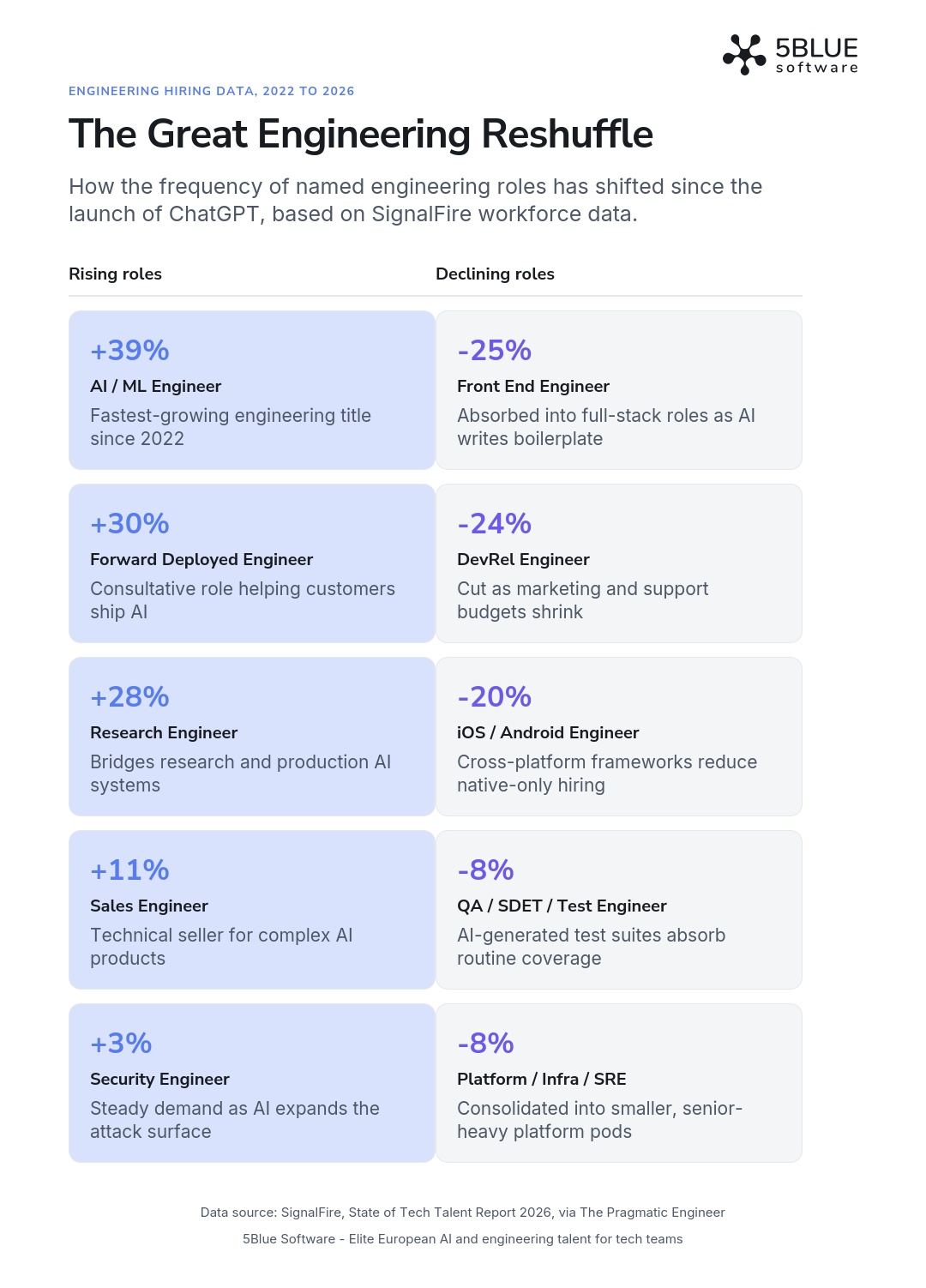
The gainers cluster around one theme: roles that sit close to AI systems or close to the customer using them.
The decliners cluster around a different theme: roles tied to a specific platform, layer, or repetitive task that AI tooling now handles well enough to consolidate.
The pattern underneath these numbers matters more than any single line item: the market is shifting from craft specialization to systemic leverage. A narrow specialist who does one thing well is worth less than an engineer whose work compounds across an AI-driven system. That's the sentence to keep in mind for every hiring decision you make this year.
It's tempting to read "AI/ML Engineer up 39%" as a story about AI replacing engineers. The data says the opposite. Tech hiring overall has fallen to about 75% of its 2019 level, but engineering has held up far better than design, product, or marketing, and early-stage startups actually hired more engineers in 2025 than they did in 2019.
What's changed is where the value sits inside engineering. Three forces are driving the roles above upward:
AI products need people who can connect research to production. Research Engineers exist because the gap between a working model and a shippable product is now a full-time job. Companies building on top of large models need engineers who understand both the model layer and the systems that surround it.
Forward-deployed roles exist because AI products don't sell themselves. Customers buying AI tools need help adopting them, wiring them into existing workflows, and getting real value out of them. That's created a genuinely new engineering discipline that sits between customer success and software delivery. It's grown 30% since 2022, and the trend has accelerated further in the last year alone.
Security has become a permanent line item, not a project. A 3% gain looks modest next to AI/ML's 39%, but it reflects something durable: every new AI system is a new thing to secure, and that demand doesn't taper off.
The uncomfortable part of this story is who's absorbing the cost. New graduate hiring at major tech companies is down roughly 65% since 2019, and closer to 76% at early-stage startups. The contraction is concentrated at the entry level, where AI tooling now handles the kind of routine, well-specified work that used to be a junior engineer's job. Senior engineers who can direct that tooling, catch its mistakes, and take ownership of outcomes are more valuable than ever. Juniors who can't yet do that are competing for a much smaller pool of seats.
The decline in frontend-specific roles isn't really a story about frontend work disappearing. It's a story about the frontend-only specialist disappearing. AI coding tools now handle a large share of routine React, CSS, and component work, and full-stack ownership has become the norm rather than the exception. If a capable engineer can review AI-generated frontend code as easily as they review backend code, there's less reason to keep the two skill sets in separate hires.
Native mobile is following a similar path. Cross-platform frameworks have gotten good enough that fewer companies see the case for maintaining standalone iOS, Android, and web teams for the same product. That doesn't mean native mobile expertise has no value. It means fewer companies need a dedicated headcount line for it.
DevRel and QA tell a slightly different version of the same story: budget pressure plus AI absorption. DevRel gets cut early when marketing and community budgets tighten, and QA/SDET work is exactly the kind of well-specified, repetitive testing task that AI-generated test suites now cover at scale. Teams that used to run three to five QA engineers are increasingly running one senior person overseeing AI-generated coverage.
None of these roles are being eliminated outright. They're being folded into broader, senior-heavy generalist positions, which is exactly why the market for that kind of talent has gotten more competitive, not less.
If you're a CTO or VP of Engineering planning headcount for the next year, this data points to a fairly specific set of moves.
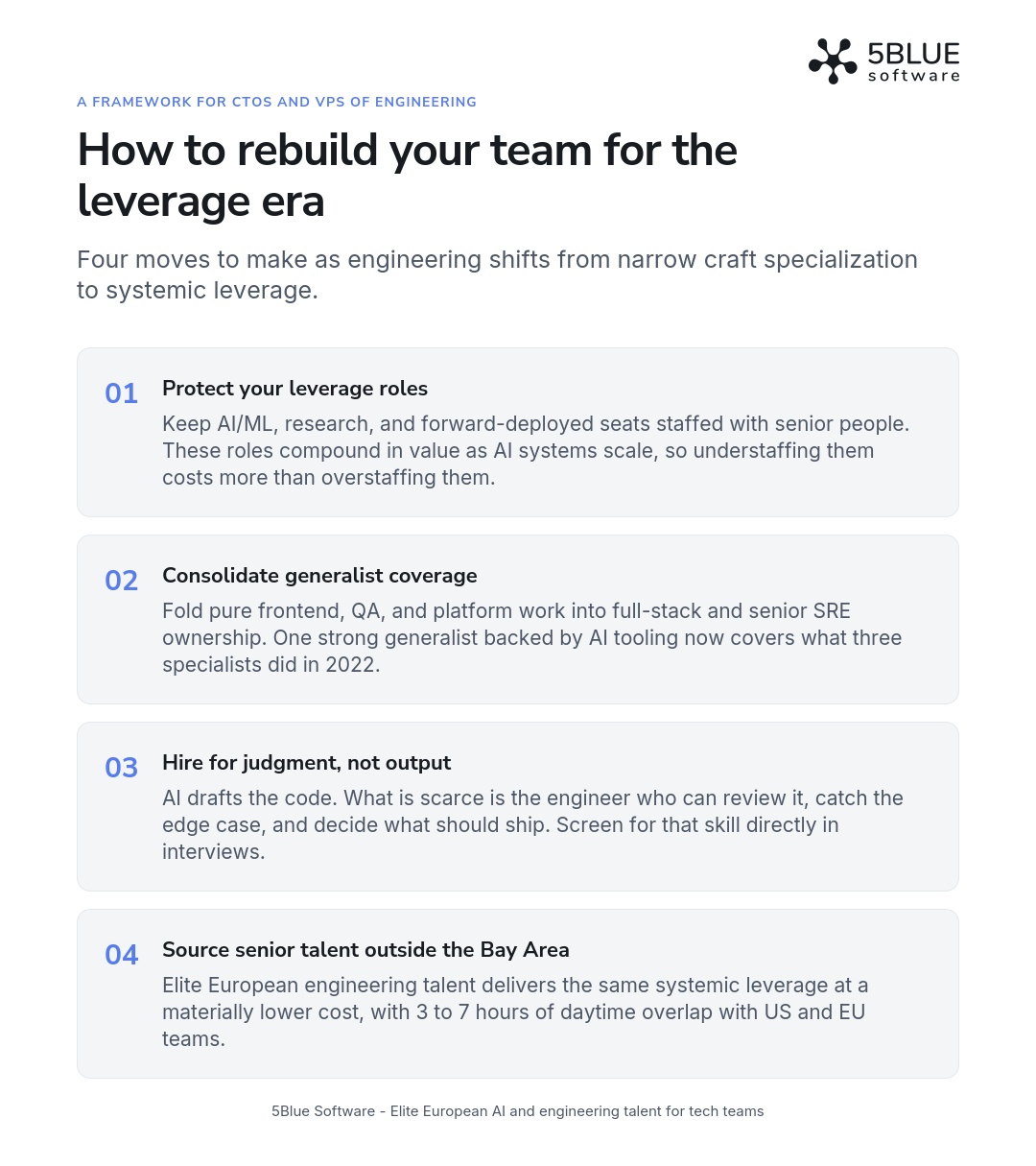
Protect the roles that compound. AI/ML, research, and forward-deployed seats generate more value the longer they're staffed with strong senior people. Understaffing them is more expensive than it looks on a budget spreadsheet, because the cost shows up later as slower AI product delivery, not as an obvious line item now.
Consolidate the roles that used to be separate. If you're still hiring standalone frontend, QA, or platform specialists for every project, you're likely paying for coverage that a smaller number of strong full-stack and senior SRE hires can now provide, backed by AI tooling.
Screen for judgment, not throughput. When AI can produce a working draft in seconds, the scarce skill is deciding whether that draft should ship. That's a different interview than the one most companies are still running.
Widen your search geographically. The roles gaining the most ground, AI/ML, research, and forward-deployed engineering, require senior-level expertise that's genuinely scarce and genuinely expensive in major US tech hubs. That scarcity is exactly why it's worth looking beyond them.
Europe has some of the deepest engineering talent pools in the world, built on a strong STEM tradition and a steady output of CS graduates from top technical universities across the continent. Engineers from these markets consistently rank near the top of global coding competitions, and European time zones give Western European teams full-day overlap and US East Coast teams a solid multi-hour working window.
That matters more in 2026 than it did in 2022, because the roles driving the current hiring shift, AI/ML, research, forward-deployed, security, are exactly the roles where senior expertise is hardest to find and most expensive to buy in San Francisco or New York. A staff-level AI/ML engineer or research engineer sourced through an outstaffing model gets you the same systemic leverage the SignalFire data describes, without the compensation premium of a Bay Area hire.
It's worth being precise about the model here, because it's often misunderstood: outstaffing is not outsourcing. You retain full control over tasks, priorities, and process. The engineer works inside your team, on your stack, under your management, at a lower total cost. It's a way to staff the leverage roles this data says you should be protecting, without competing head-on for the same shrinking pool of Bay Area senior talent everyone else is chasing.
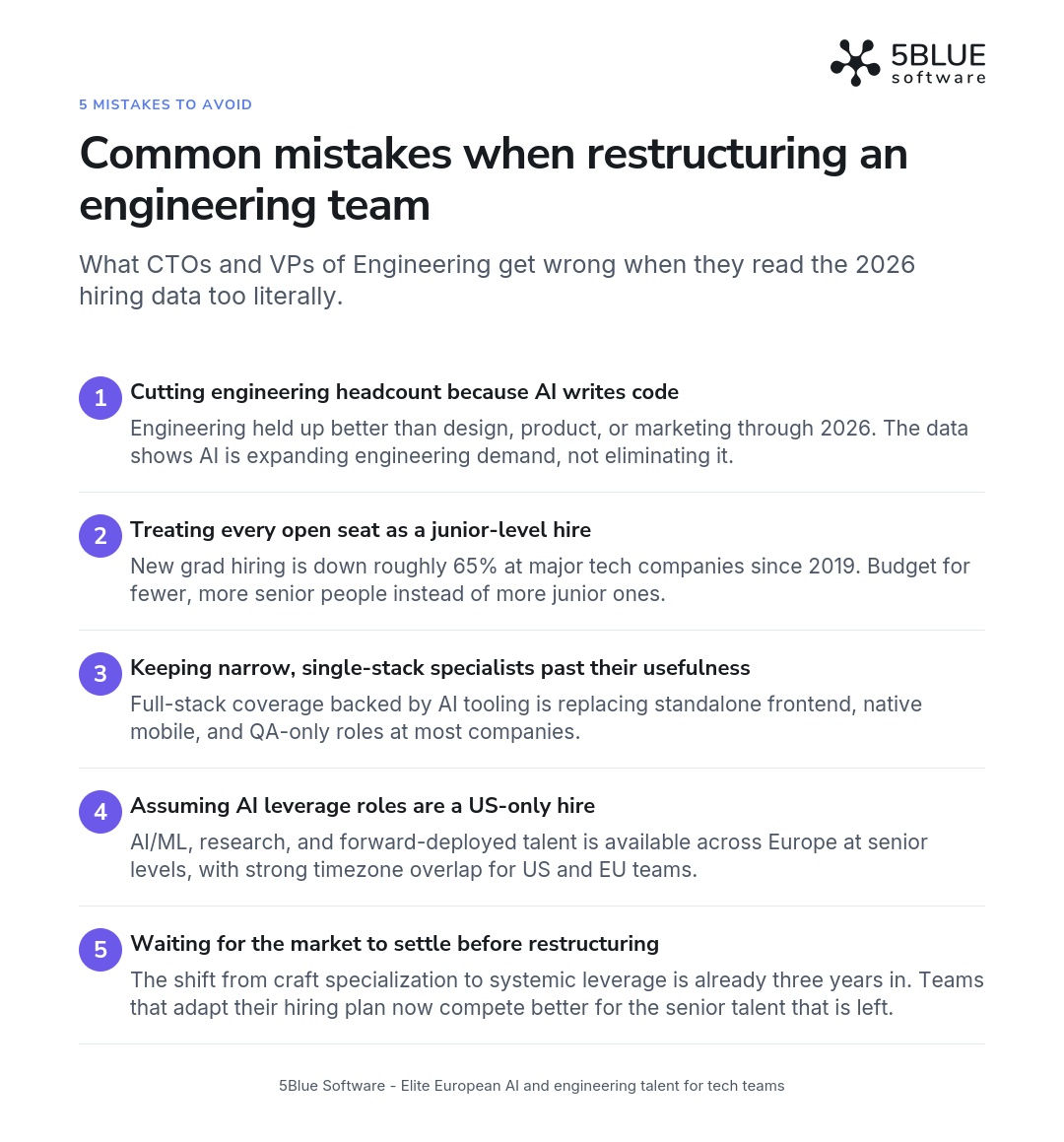
The data above is easy to misread if you only skim the headline numbers. A few mistakes come up repeatedly among teams reacting to this shift:
Cutting engineering headcount because "AI writes code now." The data says the opposite: engineering has held up better than nearly any other function through this downturn, because AI is expanding what engineers can build, not replacing the need for them.
Treating every open seat as a junior hire. With new grad hiring down roughly 65% at major companies, the market has already moved toward fewer, more senior hires. Budget accordingly.
Keeping narrow specialists past their usefulness. If your team still has standalone frontend, native mobile, or QA hires for every project, you're likely running a 2022 org chart against a 2026 market.
Assuming leverage roles have to be a US hire. Senior AI/ML, research, and forward-deployed talent exists well outside the Bay Area, at a materially different price point, with strong timezone overlap for distributed teams.
Waiting for the market to "settle" before restructuring. This shift is already three years old and still accelerating. Teams that adjust their hiring plan now are competing for talent against fewer companies than the ones who wait.
Which engineering roles are growing the fastest in 2026?AI/ML Engineer leads with a 39% increase in frequency since 2022, followed by Forward-Deployed Engineer (+30%) and Research Engineer (+28%), according to SignalFire's 2026 talent data.
Is frontend development a dying career?No, but the standalone frontend specialist role is shrinking (-25% since 2022) as full-stack ownership becomes the norm. Frontend skills tied to performance, accessibility, and design systems are holding up better than generalist frontend work.
Why is Forward-Deployed Engineering growing so quickly?Companies selling AI products need engineers embedded with customers to help them adopt and implement those tools effectively. It's a hybrid of software engineering and technical consulting that barely existed as a distinct role before 2023.
Does this data mean AI is replacing software engineers?The data points the other way. Engineering has held up better than design, product, and marketing through the current hiring slowdown, and early-stage startups hired more engineers in 2025 than in 2019. The contraction is concentrated in entry-level and narrow-specialist roles, not engineering overall.
Is it worth hiring engineering talent outside the US for these growing roles?For roles like AI/ML engineering, research engineering, and security, where senior expertise is scarce and expensive domestically, sourcing from strong European talent pools can provide the same level of skill at a lower cost, with enough timezone overlap to work as a genuine extension of your team.
If you're rethinking how your engineering team is structured for what 2026 actually rewards, it's worth looking at where the talent for those leverage roles is easiest to find at a sustainable cost. That's the conversation we have with most of the CTOs we work with.

Since ChatGPT launched in late 2022, the mix of engineering roles inside tech companies has moved more than it did in the previous decade. AI/ML engineering has grown 39%. Forward-deployed engineering, a role most people hadn't heard of three years ago, is up 30%. At the same time, frontend engineering has dropped 25%, DevRel is down 24%, and native iOS/Android hiring has fallen 20%.
None of this means engineering is shrinking. It means engineering is being rebuilt around a different center of gravity, and that has direct consequences for how you plan headcount, budget, and where you source talent in 2026.
The data comes from SignalFire's State of Tech Talent Report 2026, based on the frequency of named engineering titles across the workforce from Q1 2022 to Q1 2026. It's one of the clearest pictures available of how engineering has actually reorganized itself, as opposed to how it's talked about.
The gainers cluster around one theme: roles that sit close to AI systems or close to the customer using them.
The decliners cluster around a different theme: roles tied to a specific platform, layer, or repetitive task that AI tooling now handles well enough to consolidate.
The pattern underneath these numbers matters more than any single line item: the market is shifting from craft specialization to systemic leverage. A narrow specialist who does one thing well is worth less than an engineer whose work compounds across an AI-driven system. That's the sentence to keep in mind for every hiring decision you make this year.
It's tempting to read "AI/ML Engineer up 39%" as a story about AI replacing engineers. The data says the opposite. Tech hiring overall has fallen to about 75% of its 2019 level, but engineering has held up far better than design, product, or marketing, and early-stage startups actually hired more engineers in 2025 than they did in 2019.
What's changed is where the value sits inside engineering. Three forces are driving the roles above upward:
AI products need people who can connect research to production. Research Engineers exist because the gap between a working model and a shippable product is now a full-time job. Companies building on top of large models need engineers who understand both the model layer and the systems that surround it.
Forward-deployed roles exist because AI products don't sell themselves. Customers buying AI tools need help adopting them, wiring them into existing workflows, and getting real value out of them. That's created a genuinely new engineering discipline that sits between customer success and software delivery. It's grown 30% since 2022, and the trend has accelerated further in the last year alone.
Security has become a permanent line item, not a project. A 3% gain looks modest next to AI/ML's 39%, but it reflects something durable: every new AI system is a new thing to secure, and that demand doesn't taper off.
The uncomfortable part of this story is who's absorbing the cost. New graduate hiring at major tech companies is down roughly 65% since 2019, and closer to 76% at early-stage startups. The contraction is concentrated at the entry level, where AI tooling now handles the kind of routine, well-specified work that used to be a junior engineer's job. Senior engineers who can direct that tooling, catch its mistakes, and take ownership of outcomes are more valuable than ever. Juniors who can't yet do that are competing for a much smaller pool of seats.
The decline in frontend-specific roles isn't really a story about frontend work disappearing. It's a story about the frontend-only specialist disappearing. AI coding tools now handle a large share of routine React, CSS, and component work, and full-stack ownership has become the norm rather than the exception. If a capable engineer can review AI-generated frontend code as easily as they review backend code, there's less reason to keep the two skill sets in separate hires.
Native mobile is following a similar path. Cross-platform frameworks have gotten good enough that fewer companies see the case for maintaining standalone iOS, Android, and web teams for the same product. That doesn't mean native mobile expertise has no value. It means fewer companies need a dedicated headcount line for it.
DevRel and QA tell a slightly different version of the same story: budget pressure plus AI absorption. DevRel gets cut early when marketing and community budgets tighten, and QA/SDET work is exactly the kind of well-specified, repetitive testing task that AI-generated test suites now cover at scale. Teams that used to run three to five QA engineers are increasingly running one senior person overseeing AI-generated coverage.
None of these roles are being eliminated outright. They're being folded into broader, senior-heavy generalist positions, which is exactly why the market for that kind of talent has gotten more competitive, not less.
If you're a CTO or VP of Engineering planning headcount for the next year, this data points to a fairly specific set of moves.
Protect the roles that compound. AI/ML, research, and forward-deployed seats generate more value the longer they're staffed with strong senior people. Understaffing them is more expensive than it looks on a budget spreadsheet, because the cost shows up later as slower AI product delivery, not as an obvious line item now.
Consolidate the roles that used to be separate. If you're still hiring standalone frontend, QA, or platform specialists for every project, you're likely paying for coverage that a smaller number of strong full-stack and senior SRE hires can now provide, backed by AI tooling.
Screen for judgment, not throughput. When AI can produce a working draft in seconds, the scarce skill is deciding whether that draft should ship. That's a different interview than the one most companies are still running.
Widen your search geographically. The roles gaining the most ground, AI/ML, research, and forward-deployed engineering, require senior-level expertise that's genuinely scarce and genuinely expensive in major US tech hubs. That scarcity is exactly why it's worth looking beyond them.
Europe has some of the deepest engineering talent pools in the world, built on a strong STEM tradition and a steady output of CS graduates from top technical universities across the continent. Engineers from these markets consistently rank near the top of global coding competitions, and European time zones give Western European teams full-day overlap and US East Coast teams a solid multi-hour working window.
That matters more in 2026 than it did in 2022, because the roles driving the current hiring shift, AI/ML, research, forward-deployed, security, are exactly the roles where senior expertise is hardest to find and most expensive to buy in San Francisco or New York. A staff-level AI/ML engineer or research engineer sourced through an outstaffing model gets you the same systemic leverage the SignalFire data describes, without the compensation premium of a Bay Area hire.
It's worth being precise about the model here, because it's often misunderstood: outstaffing is not outsourcing. You retain full control over tasks, priorities, and process. The engineer works inside your team, on your stack, under your management, at a lower total cost. It's a way to staff the leverage roles this data says you should be protecting, without competing head-on for the same shrinking pool of Bay Area senior talent everyone else is chasing.
The data above is easy to misread if you only skim the headline numbers. A few mistakes come up repeatedly among teams reacting to this shift:
Cutting engineering headcount because "AI writes code now." The data says the opposite: engineering has held up better than nearly any other function through this downturn, because AI is expanding what engineers can build, not replacing the need for them.
Treating every open seat as a junior hire. With new grad hiring down roughly 65% at major companies, the market has already moved toward fewer, more senior hires. Budget accordingly.
Keeping narrow specialists past their usefulness. If your team still has standalone frontend, native mobile, or QA hires for every project, you're likely running a 2022 org chart against a 2026 market.
Assuming leverage roles have to be a US hire. Senior AI/ML, research, and forward-deployed talent exists well outside the Bay Area, at a materially different price point, with strong timezone overlap for distributed teams.
Waiting for the market to "settle" before restructuring. This shift is already three years old and still accelerating. Teams that adjust their hiring plan now are competing for talent against fewer companies than the ones who wait.
Which engineering roles are growing the fastest in 2026?AI/ML Engineer leads with a 39% increase in frequency since 2022, followed by Forward-Deployed Engineer (+30%) and Research Engineer (+28%), according to SignalFire's 2026 talent data.
Is frontend development a dying career?No, but the standalone frontend specialist role is shrinking (-25% since 2022) as full-stack ownership becomes the norm. Frontend skills tied to performance, accessibility, and design systems are holding up better than generalist frontend work.
Why is Forward-Deployed Engineering growing so quickly?Companies selling AI products need engineers embedded with customers to help them adopt and implement those tools effectively. It's a hybrid of software engineering and technical consulting that barely existed as a distinct role before 2023.
Does this data mean AI is replacing software engineers?The data points the other way. Engineering has held up better than design, product, and marketing through the current hiring slowdown, and early-stage startups hired more engineers in 2025 than in 2019. The contraction is concentrated in entry-level and narrow-specialist roles, not engineering overall.
Is it worth hiring engineering talent outside the US for these growing roles?For roles like AI/ML engineering, research engineering, and security, where senior expertise is scarce and expensive domestically, sourcing from strong European talent pools can provide the same level of skill at a lower cost, with enough timezone overlap to work as a genuine extension of your team.
If you're rethinking how your engineering team is structured for what 2026 actually rewards, it's worth looking at where the talent for those leverage roles is easiest to find at a sustainable cost. That's the conversation we have with most of the CTOs we work with.
.svg)


.svg)