
.jpg)
Demand for AI engineers has outpaced supply for four straight years, and 2026 is the year that gap finally shows up in every hiring plan. Companies that once filled a machine learning role in six weeks are now watching searches stretch past three months, while salary bands for senior AI talent in the US and UK have pushed well past what most Series A and B budgets can absorb.
If you're trying to hire AI engineers right now, the challenge isn't finding people who list "AI" on their resume. It's finding people who can ship production models, not just fine-tune a notebook. This guide breaks down what AI engineers actually cost in 2026, how to vet them properly, and how long the process realistically takes, plus where experienced teams are sourcing talent to shortcut all three problems at once.
The role itself has split. "AI engineer" now covers at least three distinct profiles, and treating them as interchangeable is the fastest way to hire the wrong person.
Most companies write one job description and expect it to cover all three. That's why so many searches stall: the candidate pool for a well-defined applied AI role is much larger than the pool for a true ML research-to-production engineer, and job posts that blur the two attract the wrong applicants entirely.
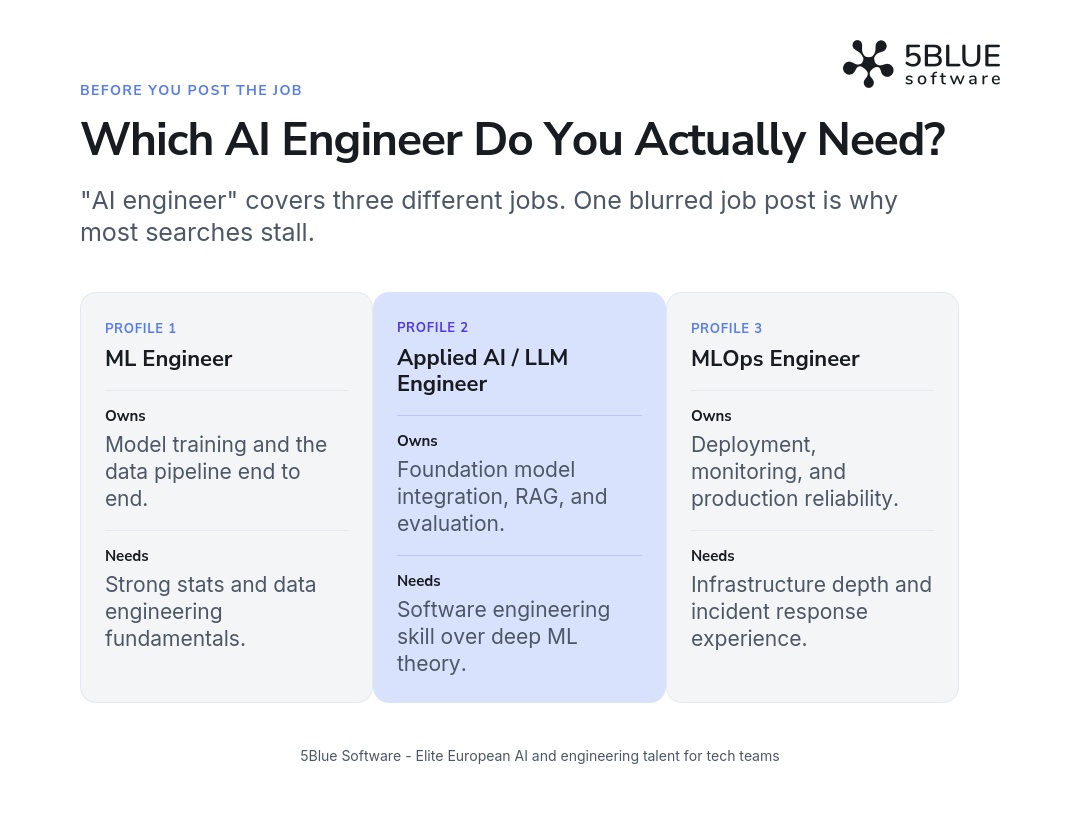
Takeaway: define which of the three profiles you actually need before writing the job spec. It changes your pricing, your vetting process, and your timeline.
Compensation for AI talent has moved faster than almost any other tech hiring category. In the US, senior ML engineers at well-funded companies now command total comp in the $220,000 to $320,000+ range, with applied AI engineers slightly below that and MLOps engineers close behind. UK and Western European rates sit lower but have still climbed 20 to 30 percent since 2024 as companies compete for the same shrinking pool of production-ready candidates.
That pricing pressure is exactly why outstaffing and nearshore hiring have moved from "cost-saving option" to "primary sourcing strategy" for many engineering leaders. A senior AI engineer sourced through an outstaffing partner in Central or Eastern Europe typically costs 40 to 60 percent less than an equivalent US hire, without the recruiting bottleneck that comes with a saturated local market.
The gap isn't just salary. Direct hiring also carries recruiter fees (often 20 to 25 percent of first-year salary), a slower funnel, and higher risk of a bad fit costing you three to six months. Outstaffing partners absorb the sourcing and vetting cost upfront and typically replace a mis-hire within weeks, not months.
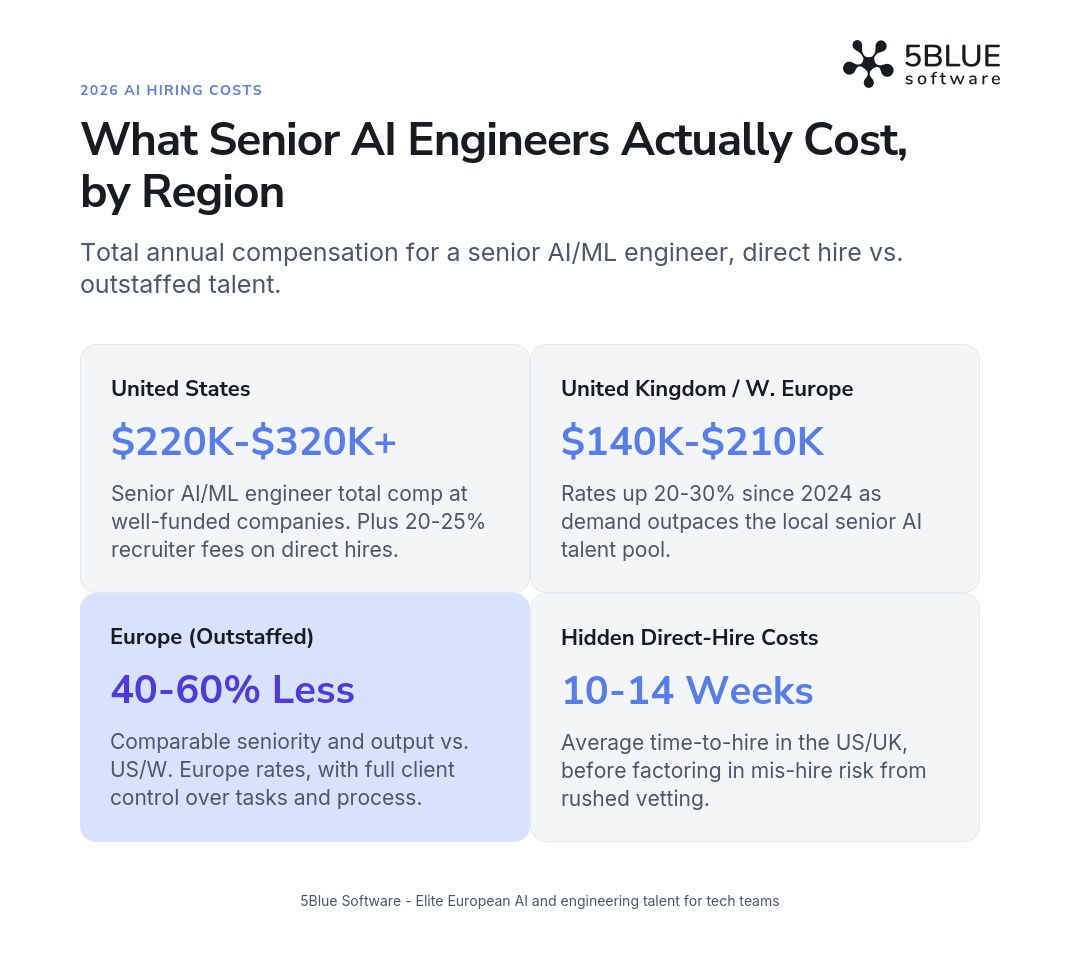
Takeaway: the real cost of hiring an AI engineer isn't just the salary line. Factor in time-to-hire, recruiter fees, and mis-hire risk before comparing direct hiring against outstaffing.
The biggest vetting mistake is testing for the wrong thing. A candidate who can whiteboard a transformer architecture but has never debugged a model that degraded in production isn't ready for most AI engineering roles, and a generic LeetCode-style interview won't catch that.
A vetting process that actually predicts on-the-job performance has five stages:
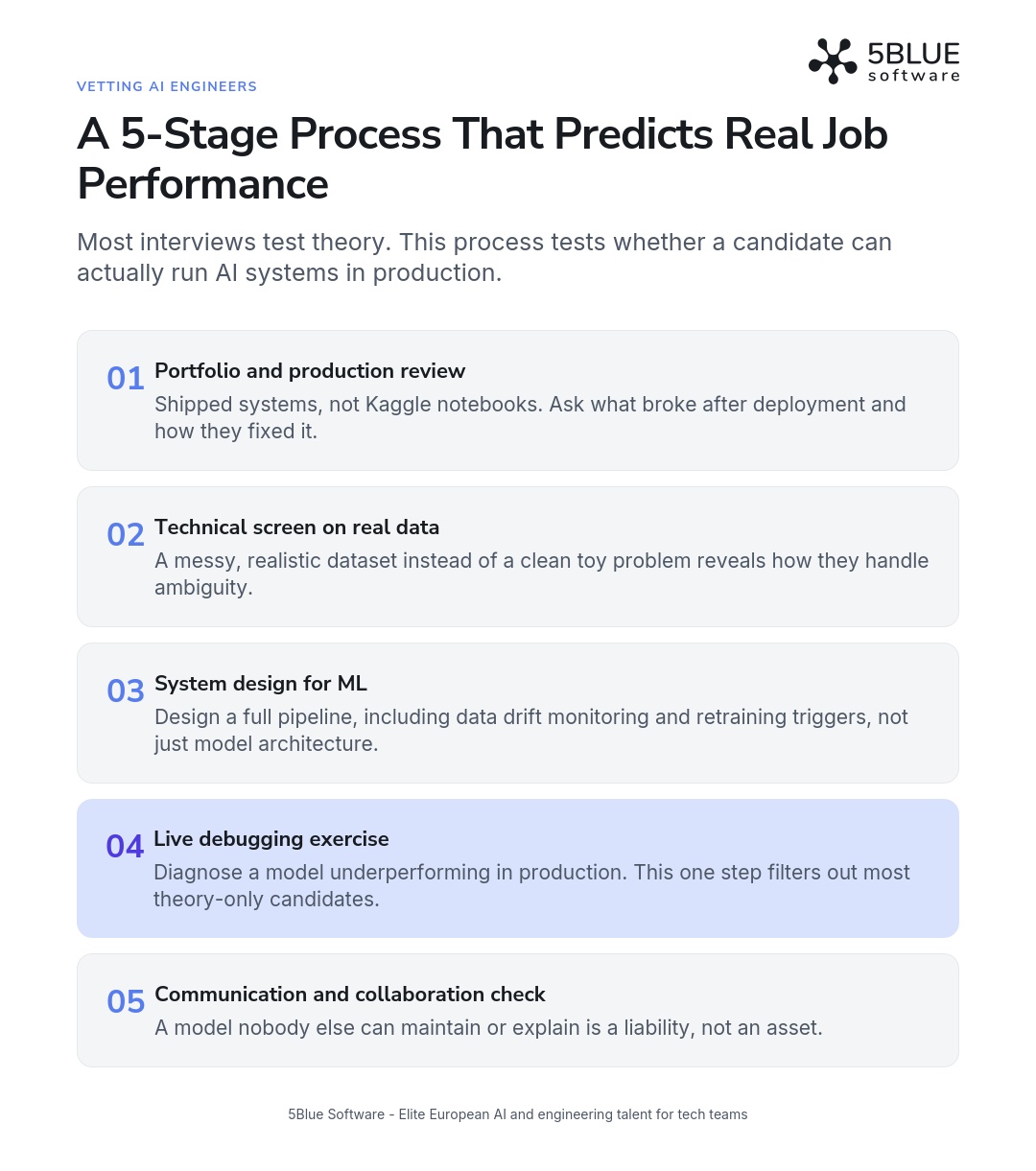
Takeaway: vet for production judgment, not just model accuracy. The debugging exercise alone eliminates most weak candidates before you get to an offer stage.
Europe's tech sector spans a deep, mature engineering talent pool, and in recent years that pipeline has shifted toward AI and machine learning faster than most Western hiring teams have noticed. Strong technical universities across Central and Eastern Europe now graduate significant numbers of engineers with applied ML and data science backgrounds each year, feeding a talent pool that's already used to remote, distributed team structures.
The practical advantages line up well with the pricing and timeline problems above:
This isn't a budget workaround. It's a sourcing strategy that happens to also solve the cost problem, which is why it's become standard practice for engineering leaders building out AI teams in 2026 rather than a fallback for companies priced out of the US market.
Takeaway: European AI engineering talent solves the pricing and timeline problems at once, without the quality compromise that "cheaper" usually implies.
Direct hiring for a senior AI engineer in the US or UK now averages 10 to 14 weeks from job post to signed offer, and that's before accounting for the roughly 30 percent of AI hires who don't pass probation because the vetting process missed a production-readiness gap. Add a 30 to 60 day notice period in many EU markets, and a "hire" can easily take four months before the person starts real work.
Outstaffing timelines look different because the sourcing and vetting layer already exists. A properly vetted senior AI engineer through an established partner can typically start within 2 to 4 weeks, with candidates pre-screened against the same production-judgment criteria outlined above rather than starting the search from zero.
The most common mistake teams make here isn't picking the wrong sourcing model. It's underestimating how long proper vetting takes and skipping steps to compress the timeline, which is how a four-month direct hire and a rushed two-week hire end up with the same outcome: a mis-hire.
Takeaway: speed and quality aren't a tradeoff if the vetting infrastructure already exists. They're only a tradeoff when you're building that infrastructure from scratch under time pressure.
Hiring AI engineers in 2026 comes down to three decisions: which of the three AI engineering profiles you actually need, a vetting process that tests production judgment rather than theory, and a sourcing strategy that doesn't force you to choose between speed, cost, and quality. Direct hiring in saturated markets like the US and UK increasingly forces that tradeoff. Outstaffing, particularly through established European talent pipelines, is how a growing number of engineering leaders are avoiding it.
If you're evaluating how to build or scale an AI engineering team this year, it's worth comparing the real cost and timeline of a direct hire against a vetted outstaffing option before committing to either path.
How much does it cost to hire an AI engineer in 2026?Senior AI engineers in the US typically cost $220,000 to $320,000+ in total compensation. Outstaffed senior AI engineers, particularly from Central and Eastern Europe, typically cost 40 to 60 percent less for comparable seniority and output.
What's the difference between an ML engineer and an AI engineer?"AI engineer" is often used loosely, but the role generally splits into ML engineers (model training and pipelines), applied AI/LLM engineers (foundation model integration and fine-tuning), and MLOps engineers (deployment and monitoring). Define which one you need before hiring.
How long does it take to hire an AI engineer?Direct hiring in the US or UK averages 10 to 14 weeks. Outstaffing through a vetted partner typically reduces that to 2 to 4 weeks, since sourcing and initial screening are already in place.
Is outstaffing the same as outsourcing?No. Outstaffing means you retain full control over the engineer's tasks and day-to-day work; the outstaffing partner handles employment, payroll, and compliance. Outsourcing hands off the project itself, including management and deliverables.
Why hire AI engineers from Europe specifically?Europe offers a large, mature STEM pipeline, strong timezone overlap with Western Europe and workable overlap with US East Coast hours, and senior AI engineering rates significantly below US equivalents, without a corresponding drop in candidate quality.

Demand for AI engineers has outpaced supply for four straight years, and 2026 is the year that gap finally shows up in every hiring plan. Companies that once filled a machine learning role in six weeks are now watching searches stretch past three months, while salary bands for senior AI talent in the US and UK have pushed well past what most Series A and B budgets can absorb.
If you're trying to hire AI engineers right now, the challenge isn't finding people who list "AI" on their resume. It's finding people who can ship production models, not just fine-tune a notebook. This guide breaks down what AI engineers actually cost in 2026, how to vet them properly, and how long the process realistically takes, plus where experienced teams are sourcing talent to shortcut all three problems at once.
The role itself has split. "AI engineer" now covers at least three distinct profiles, and treating them as interchangeable is the fastest way to hire the wrong person.
Most companies write one job description and expect it to cover all three. That's why so many searches stall: the candidate pool for a well-defined applied AI role is much larger than the pool for a true ML research-to-production engineer, and job posts that blur the two attract the wrong applicants entirely.
Takeaway: define which of the three profiles you actually need before writing the job spec. It changes your pricing, your vetting process, and your timeline.
Compensation for AI talent has moved faster than almost any other tech hiring category. In the US, senior ML engineers at well-funded companies now command total comp in the $220,000 to $320,000+ range, with applied AI engineers slightly below that and MLOps engineers close behind. UK and Western European rates sit lower but have still climbed 20 to 30 percent since 2024 as companies compete for the same shrinking pool of production-ready candidates.
That pricing pressure is exactly why outstaffing and nearshore hiring have moved from "cost-saving option" to "primary sourcing strategy" for many engineering leaders. A senior AI engineer sourced through an outstaffing partner in Central or Eastern Europe typically costs 40 to 60 percent less than an equivalent US hire, without the recruiting bottleneck that comes with a saturated local market.
The gap isn't just salary. Direct hiring also carries recruiter fees (often 20 to 25 percent of first-year salary), a slower funnel, and higher risk of a bad fit costing you three to six months. Outstaffing partners absorb the sourcing and vetting cost upfront and typically replace a mis-hire within weeks, not months.
Takeaway: the real cost of hiring an AI engineer isn't just the salary line. Factor in time-to-hire, recruiter fees, and mis-hire risk before comparing direct hiring against outstaffing.
The biggest vetting mistake is testing for the wrong thing. A candidate who can whiteboard a transformer architecture but has never debugged a model that degraded in production isn't ready for most AI engineering roles, and a generic LeetCode-style interview won't catch that.
A vetting process that actually predicts on-the-job performance has five stages:
Takeaway: vet for production judgment, not just model accuracy. The debugging exercise alone eliminates most weak candidates before you get to an offer stage.
Europe's tech sector spans a deep, mature engineering talent pool, and in recent years that pipeline has shifted toward AI and machine learning faster than most Western hiring teams have noticed. Strong technical universities across Central and Eastern Europe now graduate significant numbers of engineers with applied ML and data science backgrounds each year, feeding a talent pool that's already used to remote, distributed team structures.
The practical advantages line up well with the pricing and timeline problems above:
This isn't a budget workaround. It's a sourcing strategy that happens to also solve the cost problem, which is why it's become standard practice for engineering leaders building out AI teams in 2026 rather than a fallback for companies priced out of the US market.
Takeaway: European AI engineering talent solves the pricing and timeline problems at once, without the quality compromise that "cheaper" usually implies.
Direct hiring for a senior AI engineer in the US or UK now averages 10 to 14 weeks from job post to signed offer, and that's before accounting for the roughly 30 percent of AI hires who don't pass probation because the vetting process missed a production-readiness gap. Add a 30 to 60 day notice period in many EU markets, and a "hire" can easily take four months before the person starts real work.
Outstaffing timelines look different because the sourcing and vetting layer already exists. A properly vetted senior AI engineer through an established partner can typically start within 2 to 4 weeks, with candidates pre-screened against the same production-judgment criteria outlined above rather than starting the search from zero.
The most common mistake teams make here isn't picking the wrong sourcing model. It's underestimating how long proper vetting takes and skipping steps to compress the timeline, which is how a four-month direct hire and a rushed two-week hire end up with the same outcome: a mis-hire.
Takeaway: speed and quality aren't a tradeoff if the vetting infrastructure already exists. They're only a tradeoff when you're building that infrastructure from scratch under time pressure.
Hiring AI engineers in 2026 comes down to three decisions: which of the three AI engineering profiles you actually need, a vetting process that tests production judgment rather than theory, and a sourcing strategy that doesn't force you to choose between speed, cost, and quality. Direct hiring in saturated markets like the US and UK increasingly forces that tradeoff. Outstaffing, particularly through established European talent pipelines, is how a growing number of engineering leaders are avoiding it.
If you're evaluating how to build or scale an AI engineering team this year, it's worth comparing the real cost and timeline of a direct hire against a vetted outstaffing option before committing to either path.
How much does it cost to hire an AI engineer in 2026?Senior AI engineers in the US typically cost $220,000 to $320,000+ in total compensation. Outstaffed senior AI engineers, particularly from Central and Eastern Europe, typically cost 40 to 60 percent less for comparable seniority and output.
What's the difference between an ML engineer and an AI engineer?"AI engineer" is often used loosely, but the role generally splits into ML engineers (model training and pipelines), applied AI/LLM engineers (foundation model integration and fine-tuning), and MLOps engineers (deployment and monitoring). Define which one you need before hiring.
How long does it take to hire an AI engineer?Direct hiring in the US or UK averages 10 to 14 weeks. Outstaffing through a vetted partner typically reduces that to 2 to 4 weeks, since sourcing and initial screening are already in place.
Is outstaffing the same as outsourcing?No. Outstaffing means you retain full control over the engineer's tasks and day-to-day work; the outstaffing partner handles employment, payroll, and compliance. Outsourcing hands off the project itself, including management and deliverables.
Why hire AI engineers from Europe specifically?Europe offers a large, mature STEM pipeline, strong timezone overlap with Western Europe and workable overlap with US East Coast hours, and senior AI engineering rates significantly below US equivalents, without a corresponding drop in candidate quality.
.svg)


.svg)